I don’t believe in scripts.
I believe in positioning points.
Points that every salesperson has to hit.
There’s a flow to these points that makes logical sense. A flow that not only leaves room for conversation, but invites it.
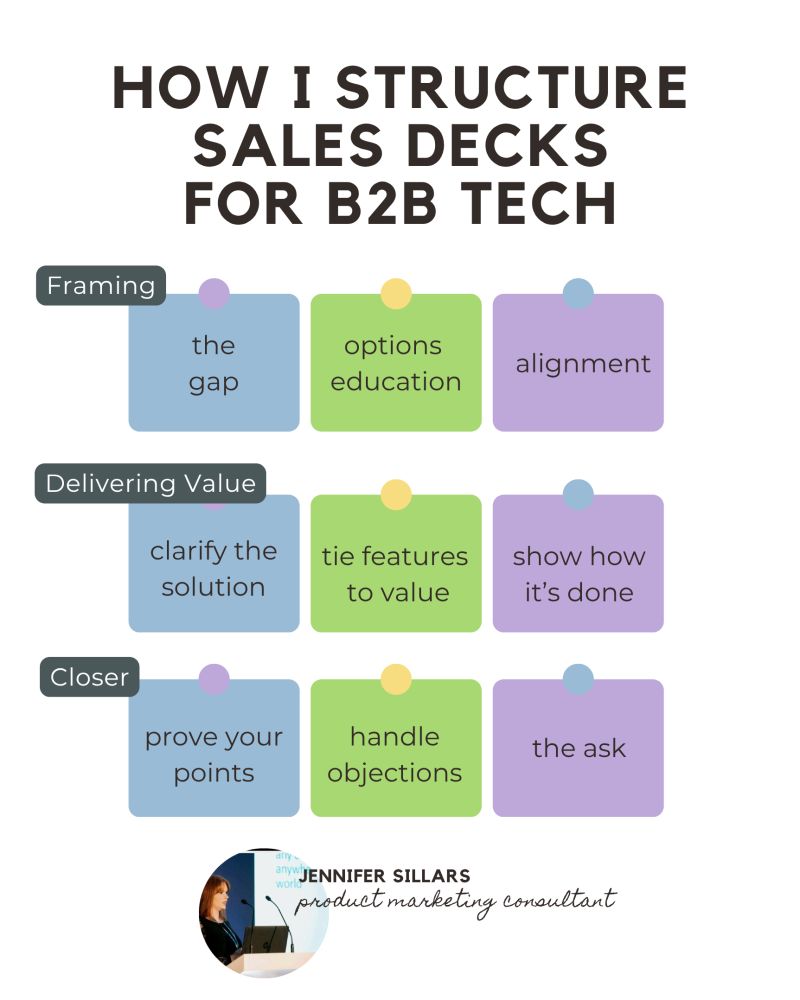
After creating 100s of decks in my career, and being heavily influenced by the one and only April Dunford, this is the structure I now use for every sales deck.
Follow this framework if you want your sales calls to be a strategic step towards market domination. Instead of an improvised dance to secure business at all costs.
The points to hit:
1. The reason that this product exists – the gap in the market that you saw and capitalised on a way no one else did. In B2B we’re in the business of solving challenges and frustrations. A strong pitch will centre this as the reason.
2. The pros and cons to different approaches to solving the problem. The competition that they’re already comparing you to.
3. Alignment on the approach that best fits the buyer’s wants and needs. Your approach.
4. A solution description that is easy to remember and repeat to their boss.
5. How the product features overcome the problem to deliver value. Arranged in memorable thematic stories.
6. Concrete examples of the product delivering value for people like them.
7. Proof that the product achieves what you say it does. Trustworthy 3rd party proof and endorsement preferably, but sometimes just ‘showing not telling’ can work.
8. Fears and misconceptions that need to be cleared up before buyers will feel comfortable moving to the next step.
9. The natural next step for someone that has been influenced by your positioning points.
Remember, every sales conversation is a test of your positioning strategy.
#productmarketing
#positioning
#salesenablement