
The future of the corporation, personal super-assistants, WPP Agent Hub, Claude Code, and vibe-coding fashion
This week’s provocation: A new type of organisation for a new era

Alex McCann has been doing some interesting writing around the current and future state of corporate work over the past year. He wrote that well-shared (I refuse to say ‘viral’) post on the death of the corporate job which seemed to resonate with a huge number of people. It added in a small way to the growing momentum around the inadequacy of modern working environments, structures, culture, and what Alex has called ‘the peculiar tragedy of talented people doing meaningless work’ (sidenote: Bruce Daisley is also excellent on this, see also David Graeber’s book on Bullsh*t Jobs).
More recently Alex McCann interviewed Bill Anderson, CEO of Bayer, on his radical and innovative approach to usurping traditional organisational structures and ways of working. Anderson has radically reorganised Bayer, a 162 year old business with 87,000 employees, significantly reducing layers of hierarchy and approval, empowering staff and pushing responsibility down the organisation to make decision-making faster and more distributed, and working in iterative quarterly cycles rather than annual plans. He calls the model ‘Dynamic Shared Ownership’ and it represents a radical shift from a traditional, bureaucratic hierarchy to a decentralized, outcome-oriented network. As Alex says, it is fundamentally about ‘replacing bureaucracy with systems that trust people’.
A lot of this really resonates with some long-term themes that I’ve been focused on. In my second book I advocated for a more agile organisation – less hierarchical, flatter structures, breaking down traditional silos with multidisciplinary working, adaptive cycles of planning and delivery. One of the biggest frustrations of working in a large business is just trying to get stuff done. The endless approvals, stakeholder management, meetings about meetings, powerpoint updates, the endless forecasts and projections which never end up reflecting reality. Nobody deliberately designs a large organisation to work in this bureaucratic, siloed and slow moving way but it inevitably emerges over time through successive, additive, stratifying iterations. Many organisations become giant cathedrals where each successive era each adds its own architectural style and complexity to the original foundation.
But I think we’re reaching a point where AI will make a radical change to how organisations are structured and the nature of work an existential necessity. The way in which we organise, deploy and coordinate work in businesses has remained largely unchanged in decades in spite of the huge shifts we’ve seen in just about every aspect of the environment in which that work is done. A year ago Lee Bryant wrote about the programmable organisation and said that AI ‘presents a once-in-a-generation opportunity to reinvent management and work coordination in ways that could substantially reduce operating costs, whilst making organisations more agile, adaptive and automated.’ AI, he said, is like a catalyst that will combine with other new ways of working (because they’re necessary to its success) to create ‘a wave of change that finally breaks through the ancient coastal defences of the C20th corporation’.
The elephant in the room here of course, is what this will mean for jobs, but I think there’s a lot in what economist Erik Brynjolfsson has says about how organisations need to think of AI in terms of augmentation rather than just substitution. And I think a lot of the principles behind what Anderson is trying to do with Bayer echo the ways of working which will also be needed to integrate AI to the benefit of both businesses, and their employees. Here’s why:
Collapsed hierarchy
When AI can synthesise information across an entire organisation and provide insights directly to decision-makers in near real-time, layers of bureaucracy become an expensive latency tax. Anderson slashed layers of management at Bayer from 12 to 6 to improve the speed of decision-making. Hierarchies were designed for an era when information travelled slowly. In an AI-augmented business the value of management shifts from information relay to applying judgment, and you simply don’t need a dozen handoffs to apply judgment.
Distributed decision-making
AI can accelerate decisions but it can also democratise the information needed to make them well. If frontline employees can access the same contextually relevant market intelligence, customer data, and predictive analytics as senior leaders, then centralised decision-making becomes a bottleneck rather than a safeguard. At Bayer, 95% of decisions were pushed down to those doing the work because proximity to the problem (or the customer) matters more now than the decision-maker’s position in the hierarchy.
No silos
Bayer’s transformation conceived internal functions as capabilities that flow to where they’re needed. In the era of AI, internal functions become composable services, partly automated and orchestrated by AI, that teams can access on demand. When finance, legal, or HR operate as internal platforms rather than gatekeeping departments, cross-functional collaboration becomes frictionless. This is an idea that I’ve written about before (Lee Bryant talks about it as well), using as an example the way that Amazon teams provide services to other teams in the organisation through APIs. AI and agentic AI now makes this service-driven architecture much more possible by handling the coordination complexity that once justified siloed structures. AI agents handle the cross-functional translation, teams can form around problems or outcomes rather than functions, and the idea of a fixed organisational chart becomes irrelevant.
Short adaptive planning cycles
The tyranny of annual plans is that they assume an environment which largely doesn’t change, and that they act against the flexibility that the business needs to adjust, reorient, and respond to fast-changing contexts. Anderson’s 90-day cycles bake deliberate and frequent reprioritisation into the cadence of how the business operates. It stops you flying blind with an outdated map, and creates a rhythm for continuous learning. When AI tracking and sensing is enabling real-time and continuous feedback loops you need a business cadence that enables much greater responsiveness.
Fluid talent flow
10-15% of Bayer’s workforce shifts focus every 90 days meaning that the organisation becomes a dynamic talent marketplace matching capabilities to emerging priorities. Static roles assume stable work and AI makes both of these obsolete. A more fluid talent flow keeps humans at the forefront of value, enables continuous redeployment, prevents expertise from calcifying, and creates the organisational plasticity that AI-augmented work requires. As Alex McCann puts it, the waste of talent and unique contribution in modern corporations is a peculiar kind of tragedy: ‘Every day you show up to be replaceable is a day the world misses out on what only you could build’. AI has the potential to empower individual agency and talent in a way we have simply not seen before. It can enable a dynamic matching of individual passion, skill, and business need. Smart people boxed into rigid job descriptions guarantees that your good people will at best be working on yesterday’s problems and at worst that they will leave.
AI as amplifier or alienator
One final thought on this. I think we’re standing at an existentially important fork in the road in the world of work. Agency and autonomy are two of the most important factors in connecting us to the value, impact and meaning of the work that we do. The ability to make decisions in the areas that we are responsible for and see the tangible benefit of our work. If AI is deployed and scaled without careful thought we risk not only cognitive outsourcing at scale but an epidemic of meaninglessness. Watching algorithms and agents make decisions that once gave a role its meaning, and reducing employees to supervisors of processes they neither understand nor can influence, is a route to profound disengagement.
But there’s another path open to us. Implemented well, AI can strip away the bureaucratic frustrations that has slowly suffocated human agency in business (the endless approvals, the report compilation, the meeting preparation that consumes hours but creates nothing). It can enable and augment a higher level of human autonomy by amplifying what humans can do uniquely well, the individual judgment in ambiguous situations, building better relationships, creating and dealing with novel solutions. Above all perhaps, it can enable us to see the direct impact of our work and decisions.
The difference lies entirely in design intent. In corporate mindfulness or corporate mindlessness. AI has the potential to amplify agency, autonomy and meaning in the workplace. Or it can lead to an epidemic of meaninglessness. It’s our choice.
Rewind and catch up:
Using AI to ask better questions
The Clown and the Editor in Creative and Strategy Workflows
On the Limitations of LLMs and the Future of AI
If you do one thing this week…
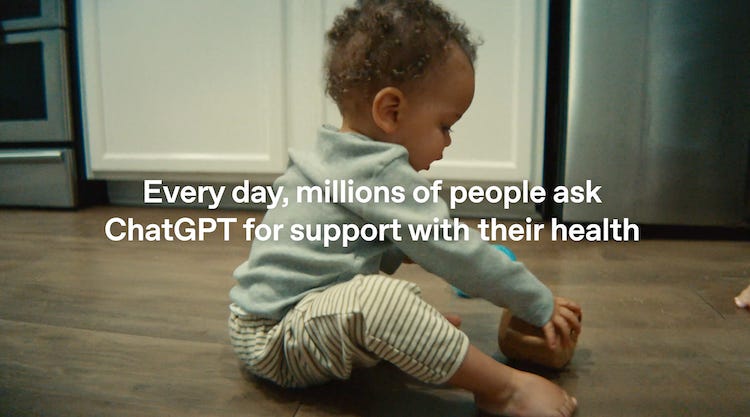
Perhaps in response to the challenge of LLM models themselves becoming somewhat commoditised and less differentiated, 2026 is going to be the year when AI engines become a lot more personalised. OpenAI’s CEO of Apps Fidji Simo recently shared their main areas of focus for the year which are clearly focused on turning ChatGPT from a chatbot into a ‘personal super-assistant’. As perhaps the first evidence of that, they have launched ChatGPT Health, encouraging users to connect their medical records. Hmmm.
Meanwhile Google launches ‘personal intelligence’, which connects all other Google services you use (Gmail, Photos, YouTube and Search) to Gemini. It means that the AI can learn about your specific contexts much better but also that it can reason across the information in your services. As Tom Critchlow noted, the implication is that all knowledge queries are becoming more contextually personalised.
Links of the week
-
WPP launched Agent Hub at CES which ‘serves as a centralized library that transforms decades of WPP’s proprietary data, strategic frameworks, and institutional knowledge into deployable AI agents’. They’ve said that it democratises access to the group’s expertise and makes it available on demand at scale, but I wonder whether it’s at all possible to democratise access to intangible, non-codifyable elements of that expertise like judgement and taste.
-
I’ve read a couple of things from non-coders on how they’re using Claude Code which has convinced me I need to know more about it than I do. Hannah Stulberg had a good primer (first part in a series) on how she set it up, and Antony Mayfield talked about how he uses it alongside other AI tools
-
‘The engineers who thrive aren’t necessarily the best programmers – they’re the ones who’ve figured out how to navigate everything around the code: the people, the politics, the alignment, the ambiguity.’ Some thoughtful lessons here from a longtime Google engineer. I particularly liked the point about trading cleverness for clarity. HT Kottke
-
Sign of the times #6577, the largest chartered accounting body the ACCA is ending remote exams because AI makes it too easy to cheat. Sign of the times #6578 China’s ‘Are You Dead?’ app checks in on growing cohort of people living alone (both FT, HT Ben Evans)
And finally…
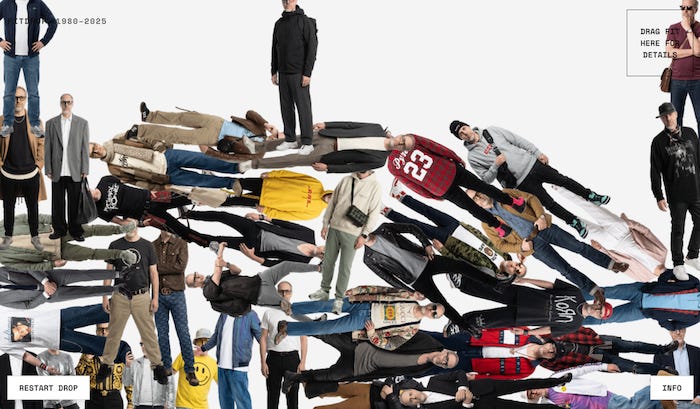
Creative Iain Tait vibe coded a great little website in a weekend which is ‘a personal exploration of fashion from 1980 to 2025’. Lots of fun. More detail on how he did it is up on Github if you’re interested.
Weeknotes
This week I was back on the road again running a session with a leadership group on change and high-performing teams and culture. I’m travelling again next week, this time working with a small group of future ecommerce leaders at an FMCG business, and also running a workshop with a consultancy business on AI transformation and strategy. It’s been a busy start to the year (which is great) but late Jan and early Feb I have some more time to dedicate to writing and exploring, which I’m also looking forward to.
Thanks for subscribing to and reading Only Dead Fish. It means a lot. This newsletter is 100% free to read so if you liked this episode please do like, share and pass it on.
If you’d like more from me my blog is over here and my personal site is here, and do get in touch if you’d like me to give a talk to your team or talk about working together.
My favourite quote captures what I try to do every day, and it’s from renowned Creative Director Paul Arden: ‘Do not covet your ideas. Give away all you know, and more will come back to you’.
And remember – only dead fish swim with the stream.