The next big leap in Travel AI isn’t a smarter model. It’s a better user interface (UI).
When the internet first went mainstream, it was essentially a directory. Yahoo and Google were indexing information. The real boom happened when applications built interfaces on top of that directory – making data visual and transactional.
We are currently in the ‘directory phase’ of the AI revolution. But does chat really work? Travel exposes that limitation faster than almost any category.
My argument is chat serves as a great initial discovery tool for travel, but it’s a fundamentally broken interface for decision-making and execution.
Why chat UI falls short for travel
In the physical world, every product category has evolved a distinct digital interface to match the user’s mindset.
-
Amazon prioritizes specs and warranty details on the product page when you are buying a utility (Ex: razor)
-
DoorDash prioritizes visuals because you eat with your eyes; a menu without pictures of the signature dish doesn’t convert
-
LinkedIn prioritizes professional background because you care most about the experience fit
Currently, generic AI Chatbots try to force all these distinct experiences into a single, uniform text stream. This works for simple queries, but information alone isn’t enough.
When you book a hotel, you aren’t just buying a bed; you are buying a ‘Lagoon’ view. This isn’t to say every vertical within travel needs an experience for itself. When I book a rental car on Avis, I am buying a utility. I just need to know if its an intermediate SUV that can fit my check-in bags. Text works fine there. But when I book an all-inclusive resort in Cancun, I am buying a memory. I’m willing to pay a grand extra for the vibe, the view, and the atmosphere. You can’t text a ‘vibe.’ You have to show it.
Why AI chat has worked for travel (so far)
Despite its visual flaws, chat-based AI initially won users over in travel for one specific reason: Discovery. When tools like ChatGPT entered the picture, users tolerated the clunky, text-heavy experience because the value was novel. Suddenly, you could ask: ‘Where should I go in December with a toddler?’ or ‘Is Switzerland or Japan better for first-time skiing?’
For the first time, discovery became conversational. But while conversation is great for initial discovery, it breaks down fast when you move to a decision.
Why travel AI needs a fundamentally different UI
There are three structural elements to generate the perfect trip on chat. I call them – The Inspiration gap, The ‘Aha’ hunt, and The Scroll trap.
-
The Inspiration gap (visual trust): The ‘Where should I go’ phase is fundamentally broken on transactional platforms today. A lot of real discovery today happens on Instagram and TikTok, where influencers and friends provide a visual glimpse of the experience. This type of inspiration demands authentic imagery from sources you trust. It cannot be replicated by a text bot describing a scenic view. AI needs to bridge the gap between the vibe of a TikTok feed and the utility of a booking engine.
-
The ‘Aha’ hunt (emotional transaction): The average traveler visits 240+ pages before making a booking. My belief is this extraordinary feat isn’t because they love research (although I do!), but because they are hunting for the stars to align. I might start with a logical checklist: Family room, pool, ground floor, free breakfast. But my ‘Aha’ moment is finding the room that meets those needs and has an ocean view. It’s the moment logistics match the dream. This requires depth in research and visual verification, not just ticking boxes in a chat window.
-
The Scroll trap (linear chat vs simultaneous reality): The final hurdle is keeping the pieces visible. Travel isn’t a linear to-do list; it is a simultaneous equation. Consider the ‘Swiftie test’. You are planning a trip from Seattle to London for the Eras Tour with strict variables: Concert seats in Section 120, a non-stop flight, and a hotel capped at $150/night – all while keeping the total budget under $3,000. Chat interfaces force these distinct variables into a single, vertical thread. As soon as you ask about the hotel, the flight details scroll off-screen. To compare options, you are forced to scroll up and down, relying on your own memory to stitch the trip together. It turns travel planning into a memory test because the UI cannot hold multiple truths (flight, hotel, event) visible at the same time. The Chat UI forces you to backtrack, scroll up, re-type prompts, and play 20 questions to see if a cheaper flight might save the budget.
But if the challenges are clear, why haven’t we overcome them yet?
Why it’s complex to engineer these elements
The challenge to solve for these structural elements is three fold. One, the data required to power these three pillars is locked in separate silos. Two, the business incentives for each of these siloes haven’t aligned (yet). And third, such interaction needs a modern data architecture.
Building the perfect UI requires merging three distinct layers of data that aren’t as connected today:
-
Vibe layer: Social platforms like Instagram and TikTok hold the inspirational visual content that drives the initial desire
-
Inventory layer: Companies like Airbnb, Hertz and Alaska Airlines hold the hard data – prices, availability, and specs.
-
Context layer: Google owns the living world data—weather, traffic, opening hours, and real-time busyness.
However, AI has altered the equation. For the first time, hungry travelers are turning to LLMs to build a perfect itinerary. Even a small shift in decision-making toward LLMs now threatens the core business incentives of every incumbent layer – lesser engagement on Instagram, fewer up-selling opportunities for OTAs and lost search traffic for Google.
It would be naive to suggest that UI alone is the silver bullet. We cannot gloss over the reality of the infrastructure. The legacy GDS (Global Distribution System) remains a bottleneck. You cannot build a dynamic, shapeshifting interface on top of static, 1980s architecture. True innovation will require a serious overhaul of the plumbing – shifting toward real-time, bi-directional access and API-first technology.
The Interface of the Future
Since mid-2024, we started seeing the cracks in the chat-only wall:
-
It started with an (almost forced) Dynamic UI within LLMs: Ask for ‘skiing options’ on ChatGPT, and instead of a text list, the AI dynamically generates a comparison table of snow depth, lift ticket prices, and a visual map of the slopes – instantly. Add to that a clunky interface in parallel that shows a few pictures when you click.
-
Moved to App integrations: The integration of OTAs (Ex: Booking, Expedia, Vrbo) within ChatGPT was the next step giving access to first-party data and getting closer to a transaction.
-
And finally, Google Canvas: I’d argue this is a criminally underrated shift. It suggests a future where the AI co-creates the itinerary with you visually, rather than just listing it.
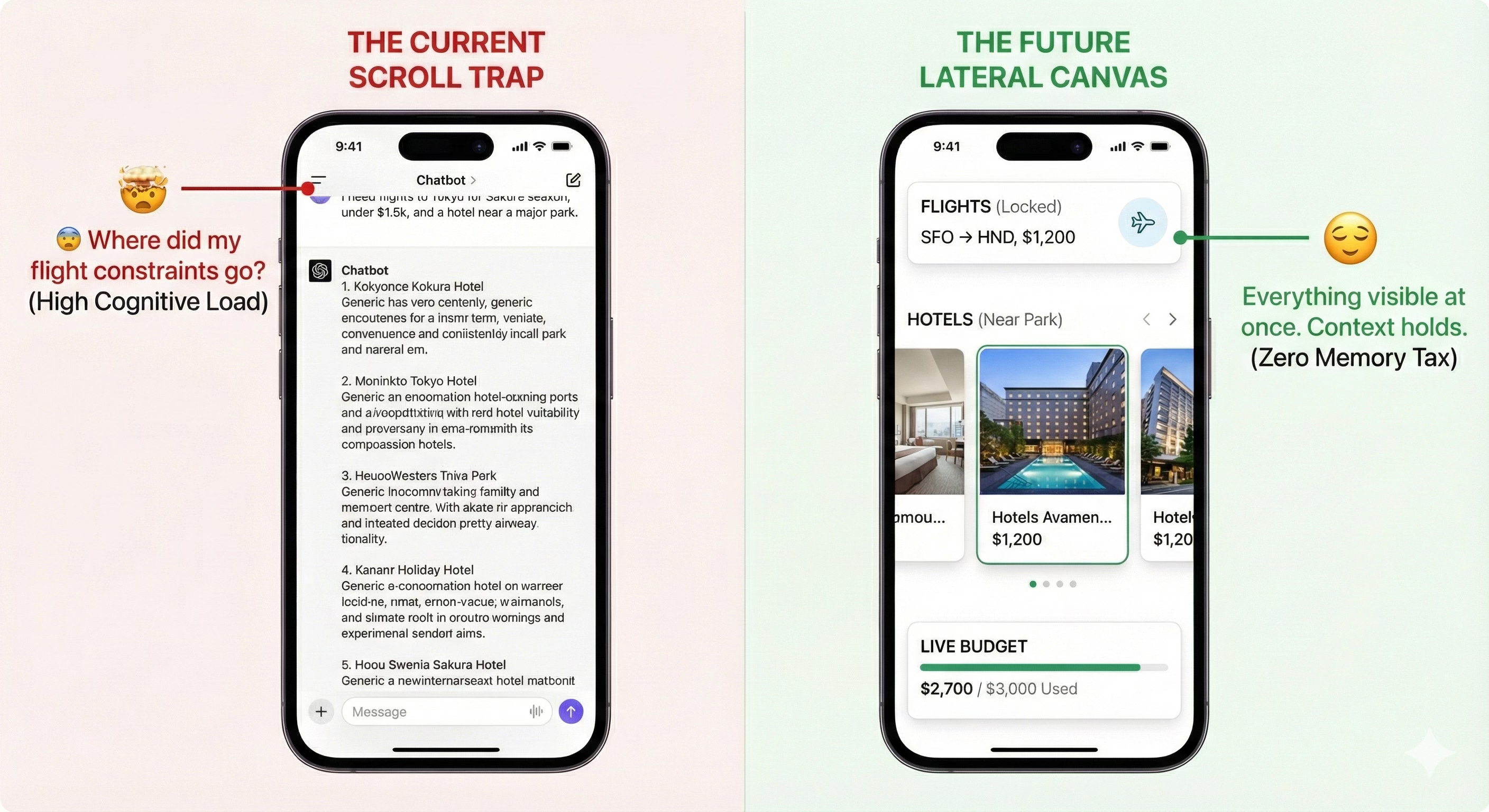
Courtesy: NanoBanana Pro
I envision a future where Travel AI isn’t a static website, but a shapeshifter that adapts to your intent. Imagine you are deciding between Bangkok and Phuket. The interface shouldn’t just list hotels; it should generate a dynamic visual backdrop – contrasting the neon energy of Patong Beach against the serene gold spires of the Grand Palace. You don’t read the difference; you feel it. As soon as you click Patong, the UI adapts, discarding cultural tours to prioritize nightlife and resorts while the AI quietly runs the teardown in the background – filtering for visa requirements, flight connections, and your $2,000 budget. Finally, the execution moves to an almost invisible layer. Instead of pressing ‘enter’ ten times to re-validate identity and payment data that has been stored forever, the friction of booking dissolves into a single permission: ‘Book it’.
Conclusion
2025 was a landmark year for what AI brought to the travel industry. Travelers finally had an interface for discovery, while large companies leveraged AI for operational efficiency and marketing margins.
My bet is that 2026 will be the pivot point toward experience. The winner in Travel AI won’t be the one with the smartest chatbot; it will be the one that realizes travel is an immersive experience and builds a User Interface that reflects that.