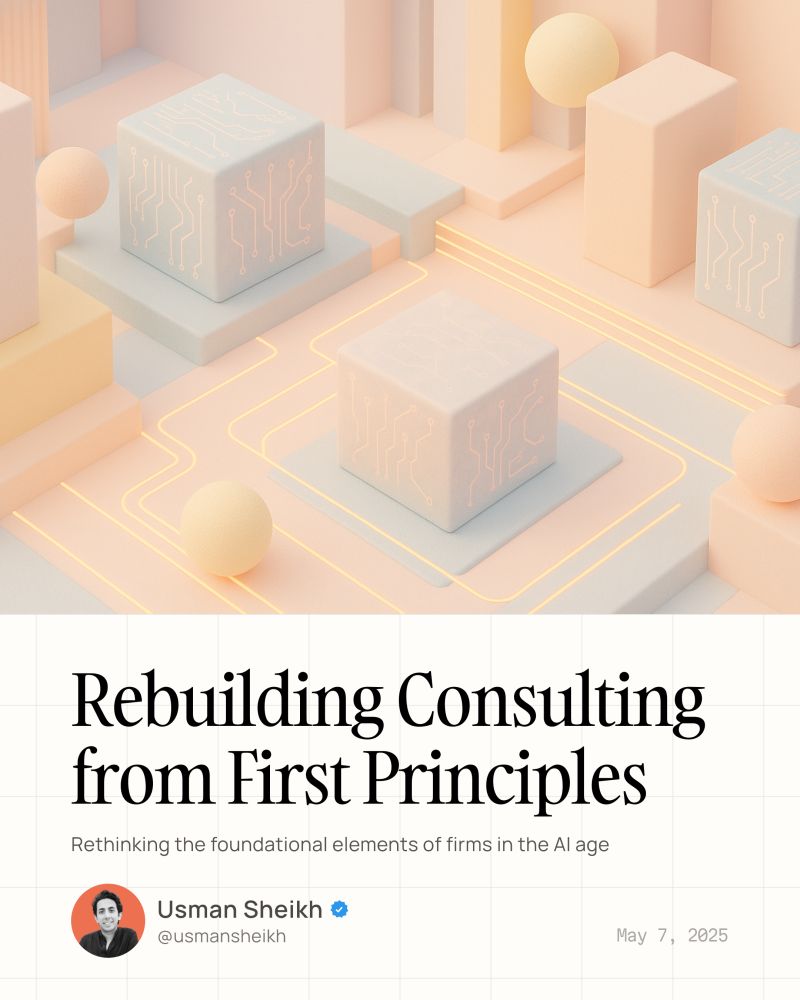
Consulting firms don’t need a new strategy.
They need to rebuild from first principles.
Incremental adjustments aren’t enough.
AI is reshaping the value proposition of consulting.
Client engagements are transforming:
→ From static deliverables to continuous partnership
→ From « trust our analysis » to « let’s co-create solutions »
→ From quarterly check-ins to real-time collaboration
→ From knowledge transfer to capability building
Reinvention requires abstraction and clarity.
We must first clearly define each foundational element driving how consulting firms create and deliver value:
Core Strategic Foundations
→ Value Definition:
How the firm identifies problems, frames solutions, delivers impact, and continuously validates outcomes aligned directly to clients’ strategic goals.
→ Insight Engine:
Frameworks, methodologies, and capabilities that generate distinctive, actionable insights.
→ Competitive Moat:
Unique proprietary data, benchmarks, industry-specific insights, or defensible intellectual property competitors cannot easily replicate.
Economic & Commercial Model
→ Economic Model:
Hourly billing, fixed-fee, subscription retainers, outcome-based fees, aligning incentives directly to client value created.
→ Commercial Engine:
Lead generation processes, structured proposal methodologies, pitch execution, pipeline management, and growth-focused client expansion systems.
Talent & Governance
→ Talent Architecture:
Hiring, training, retention strategies, compensation banding, fractional expert networks, hybrid teams, and agile/remote workforce structures.
→ Governance Structure:
Partner-led, equity-based, hierarchical or agile structures shaping decision-making, accountability, incentives.
Client Relationships & Delivery
→ Relationship Infrastructure:
Account management, executive touchpoints, trust-building activities, structured feedback loops, and relationship governance strategies.
→ Delivery System:
Operational structure, processes, tools, and methodologies used to consistently produce and deliver client outcomes.
Operational & Knowledge Systems
→ Operating System:
Project management systems, standardized processes, financial reporting mechanisms, resource allocation models, and delivery quality frameworks.
→ Knowledge & Technology Core:
Internal knowledge bases, AI-driven insights, digital twins, residual data (systems smarter after every client interaction), and proposal libraries.
With these foundational elements clearly defined, we can now rethink each with an AI-first mindset.
The consulting firm of the future won’t emerge by default.
It will be built by design.
Consulting leaders please share your insights:
→ Is there an essential element missing above?
→ Which elements are most critical to redesign?
→ Which components would benefit from deeper exploration?