Search transformed dramatically in 2025. Learn about the biggest changes in SEO & AI search, including my observations, hot takes, and thoughts about where search is headed in 2026.
2025 marked my 15th year working in the SEO industry, and it was easily the most volatile year yet. We faced an industry-wide identity crisis triggered by the meteoric rise of OpenAI’s ChatGPT and competing AI assistants like Gemini, Perplexity and Claude. For the first time in a long time, Google faced serious competition and a legitimate threat to its business model.
ChatGPT’s exponential growth kicked off in late 2022, when it became the fastest-growing consumer app of all time, reaching 100 million monthly active users within 2 months of its launch. By March 2025, ChatGPT’s growth had reached new heights, with weekly active users doubling from 400 million in February to 800 million by the end of March.
It seemed that Google was initially blindsided by the viral success of ChatGPT, which is somewhat ironic, given that it was Google’s own researchers who wrote the 2017 ‘Attention is All You Need’ paper, gifting the world the Transformer architecture that ultimately led to the creation of ChatGPT. In late 2022, Google declared its first ever publicly-documented “Code Red,” responding to ChatGPT’s rise as a streamlined, conversational alternative to traditional search.
This AI-driven panic thrust our industry into the spotlight. CMOs, investors, and tech entrepreneurs all rushed to board the AI search hype train. Brand new marketing companies and gurus arose from the ether, flooding social media feeds with AI-generated ads and formulaic posts, all echoing the narrative that without their revolutionary approach to AI search optimization, businesses would be left in the dust.
Central to this narrative was the familiar refrain “SEO is dead”- resurrected once again to capitalize on fear, uncertainty, and doubt, and to position AI search as an entirely new, cutting-edge discovery channel.
The Great Acronym Gold Rush & GEO Grift
What followed was a naming frenzy. It was a revolving door of still-to-this-day disputed labels for what was framed as a fundamentally new marketing skillset.
2025 was the year of GEO (Generative Engine Optimization), otherwise known as AEO (Answer Engine Optimization) – my personal preference – along with AI SEO, LLMO, and various other creative new titles. These names were all competing for dominance within a new trade many believed would make their predecessor, SEO, obsolete.
Starting at the top of the year and ramping up throughout 2025, we heard from thousands of voices and viral posts across LinkedIn, X, Reddit, and YouTube about how SEO, like Google, was apparently now a thing of the past. In many cases, a quick profile search would reveal that these voices often belonged to folks who had newly entered the space, and/or who had a new AI tool to sell.
We even learned later in the year about coordinated “GEO disinformation campaigns,” where emerging GEO tools allegedly offered payment to micro-influencers behind closed doors in an effort to promote this exact narrative across social media.
RIP to All of Our Inboxes
For those of us managing SEO teams, this hype cycle dealt the ultimate death blow to our already-overflowing inboxes. The year was full of a relentless influx of sales pitches from new tech startups selling magic bullets to help our brands and agencies win in AI search.
One of the most fascinating aspects of this hype cycle was that within just a few months, so many tech founders and GEO gurus had become self-proclaimed experts in this nascent field. This was especially curious, given that OpenAI’s own employees stated in 2023 that “language models have become more capable and more widely deployed, but we do not understand how they work.”
The Bait and Switch
Over time, one pattern became increasingly clear: many of the loudest voices declaring the death of SEO also appeared to have the greatest lack of context, history, and understanding about how modern SEO actually works, or what professional SEOs actually do all day.
Looking under the hood of their recommended approaches revealed the obvious to any experienced SEO practitioner: many such GEO grifters were using this opportunity to simply repackage core SEO approaches using a different name. (I made a lighthearted video about this, by the way.)
In many cases, the ‘novel’ GEO recommendations they made for driving AI search visibility were verbatim recommendations that SEO teams have been making to their clients for years, if not decades.
“Structured data is the key to AI search visibility,” they would proclaim, as if discovering fire, “and don’t forget to break your content up into highly scannable chunks using optimized
–
tags with a clear topical focus, descriptive titles, and concise language that directly answers real user questions. Don’t forget to use keyword-optimized URLs and meta descriptions.”
Any experienced SEO professional should struggle to find anything truly new or revolutionary in these recommendations.
In other cases, risky GEO recommendations caused seasoned SEO professionals to raise an eyebrow: “Use AI to generate thousands of new pages to increase your topical coverage and brand salience in AI search.” “Buy a dozen 5-year-old Reddit accounts with 10k+ karma to seed ‘organic’ recommendations in top subreddits to trigger a “consensus” signal.” “Include hidden instructions for LLMs using white text on a white background.” “Create separate, scaled down versions of all of your pages for easy ingestion by AI crawlers.” “Write for bots, not for humans.”
As I recently said on X, some of y’all have never faced the wrath of the Helpful Content Update and it shows.
Many of these recommendations are frankly dangerous for SEO (and in tandem, AI search performance, but more on that later). They risk flooding the search index with low-quality, automated content that can lead to algorithmic demotions and penalties; they create potential nightmare scenarios with managing duplicate content; and they use unproven and sketchy methods to artificially manufacture visibility in unsustainable ways that create no real value for users.
How Vibe Coding Probably Made Things Worse
It’s no coincidence that 2025 was also the year where it became easier than ever to spin up new software, thanks to the rise of « vibe coding. » When products like Cursor, Claude Code, and Lovable can help a non-developer generate an AI search tracking tool in a few hours, it makes sense that our inboxes would be filled with daily requests to try someone’s new product. The messages haven’t slowed down in early 2026, by the way.
We are now in a situation where there are far too many AI search tools circulating in our industry, and not enough users to pay for all of them. Furthermore, incumbent SEO tools like Semrush, Ahrefs, Conductor, and Similarweb have all launched their own AI search visibility offerings, leveraging a massive structural advantage: an existing enterprise user base. While a solo developer can “vibe code” a brilliant standalone feature in a weekend, the incumbents already own the contracts, the security clearances, and existing relationships with marketing teams. For many companies, especially bigger brands, it is much easier to adopt an AI add-on from a trusted, established vendor than it is to bring on a new contract.
The Rise of LLM Tracking & AI Search Visibility Monitoring
In 2025, we also saw massive amounts of venture capital flow into the AI search marketing industry. Everyone was hungry for a piece of the pie. This surge was highlighted by Adobe’s $1.9 billion acquisition of Semrush in November 2025, a move Adobe specifically made to secure « Generative Visibility » tools. There was a serious demand for solutions for monitoring brand visibility in AI search.
Emerging AI search visibility monitoring platforms like Profound and Peec AI (which raised a $21 million Series A in November 2025) reflected this urgent demand for tracking brand presence in LLMs. This was all part of a broader $202.3 billion AI investment wave, where AI captured over half of all global VC value, according to IDC and PitchBook data.
However, there are significant challenges with LLM tracking that apply to all providers of this technology: while these tools are useful for directional insights, they remain fundamentally limited by the ‘black box’ of the user experience. Unlike traditional search, where a keyword generally returns a standardized set of results (with some light personalization), LLM responses are both non-deterministic and increasingly personalized. They account for a user’s unique conversation history, their specific ‘Memory’ settings, their interests, and even their geographic nuances in ways a logged-out third-party scraper simply cannot replicate.
Furthermore, we are operating in an era where ‘search volume’ as we once knew it is much less reliable for AI search; it is currently impossible to track exactly what real LLM users are asking in aggregate. Any prompt volume data provided by these new tools is, at best, highly directional and greatly sampled.
The massive influx of capital into AI search tracking tools created a gold rush and captured the industry’s attention throughout the year. Alongside LLMs directly scraping search results, these LLM trackers contributed to an already skyrocketing surge in crawling activity on Google. This surge even forced Google to act – not only cutting off the ability to scrape 100 results at a time, but also suing SerpAPI to limit scraping that violated their guidelines. So while 2025 left us with no shortage of options for tracking responses from LLMs, we still lacked a consensus on how to actually influence them.
The “New” Mechanics of Traditional SEO
As the year went on, our industry collectively shared new research, experiments, and theories to help each other wrap our heads around the inner workings of AI search.
Some of the most memorable articles and posts that changed the way I think about AI search throughout the year included:
-
Jérôme Salomon’s LinkedIn post about what happens behind the scenes when ChatGPT launches a web search, and how to extract the search queries it uses
-
Alex’s Rylko’s discovery that ChatGPT is likely using Google for web search in addition to Bing
-
Dan Petrovic’s articles detailing how the transition to GPT-5 rendered SEO more irreplaceable than ever because the model is designed as a « reasoning engine » that offloads factual knowledge to external search tools, such as using RAG for web search, rather than relying on its internal weights.
-
Also from Dan Petrovic: his research into the grounding chunk mechanism which demonstrates that Google’s AI process operates on a strict « grounding budget » of roughly 2,000 words, where the system extracts only small, sequential slices of a page – often as little as 13% of a long-form article
-
Oliver de Segonzac’s post about how ChatGPT Search uses multi-layered fan-outs; uses SerpAPI to scrape Google Shopping and names entities in the conversation
-
Britney Muller’s post that challenged the industry’s perception of AI by arguing that LLMs are not search engines but are instead “non-deterministic probability machines” that the industry is essentially “rediscovering” SEO through AI search.
-
Britney emphasized that every single URL surfaced in an LLM response is not generated by the model’s “brain” but is pulled from a live search index, meaning visibility in AI is fundamentally dependent on traditional search engine crawling and indexing
-
-
David McSweeney’s post describing his theory for how ChatGPT actually generates answers, from start to finish: “ChatGPT Is a Search Engine. Here’s How It Works.”
Throughout the year, I also couldn’t help but notice a pattern in my own experimenting with AI search: every time I wrote an article in 2025 – whether it was published on my personal blog, our agency blog, Amsive Insights, LinkedIn Pulse or other social media posts, or search-industry publications like Search Engine Land or Moz, I would see my article cited within a few hours across various LLMs.
This same pattern was true for other colleagues, and teammates’ new articles. It was true without doing anything new or different for AEO/GEO outside of standard SEO best practices. It worked every time because LLMs use search engines, and the articles were quickly indexed and ranked well in web search. It’s really as simple as that.
I certainly thought about that detail every time I heard anyone promise that they knew the secrets to appearing in AI search answers.
So, where did things land? In my opinion, several nuanced takeaways about AI search can be true at the same time:
-
AI search has introduced a significant paradigm shift in searcher behavior, as more and more users start their searches directly on AI assistants like ChatGPT or Gemini.
-
AI assistants function fundamentally differently than search engines. While traditional engines prioritize retrieval (indexing and ranking), LLMs focus on synthesis – generating cohesive, direct answers by weaving together information from a variety of sources.
-
The metrics for AI search success have naturally diverged from traditional SEO. Because AI surfaces are conversational and designed to provide immediate answers, they are built to answer queries directly in the user interface. This inherently reduces the “click-through” traffic that has historically helped to define SEO success. Organic traffic will naturally decline in this new environment.
-
We must respond by developing new metrics to measure AI search success that focus on conversions and revenue, brand visibility, share of search, competitive positioning, and brand demand.
-
-
Many opportunists have positioned this shift as a total departure from existing organic search strategies. However, the reality is much more measured. While there are distinct differences – especially in the search interfaces, the prompting experience, and the metrics used to measure impact – many, if not most, of the actual tactics to drive AI visibility haven’t changed much. They are simply evolved versions of existing SEO, branding, and digital PR processes.
-
Ultimately, AEO/GEO is not an overhaul or abandonment of SEO. Instead, it represents a new system for competing for, capturing, and measuring success across AI platforms. It is an expansion of the digital marketer’s toolkit, complete with new tools and a shift in prioritization for how to conduct organic marketing activities.
-
Furthermore, a solid, cohesive SEO, social media & digital PR strategy is by far the most effective way to capture visibility in AI search. Unless LLMs find a way to generate accurate, up-to-date answers without relying on search engines, SEO will continue to remain imperative for AI search success.
-
AI search represents a classic evolution of SEO and not unlike other evolutions we’ve experienced throughout SEO history – like the rise of voice search, mobile-first indexing, social signals, semantic search, image/video search, Amazon, TikTok, and YouTube SEO, E-E-A-T, and more.
What tactics have actually changed with AEO/GEO?
Query Fan-Out
I believe one of the most significant developments in our understanding of AI search mechanics came from deconstructing the Retrieval-Augmented Generation (RAG) pipeline. We began to see a clear, binary split in how LLMs handle intent: they either lean on their static training data or, increasingly, trigger a real-time web search for factual grounding.
When a system determines a query requires factual grounding or up-to-date information, it uses an LLM to deconstruct the prompt into multiple sub-queries – a process known as “query fan-out.” These queries are executed simultaneously across search indices (including Google and Bing) to gather a diverse set of source data, which the model then synthesizes into a single response.
There are various new tools and models that enable us to emulate the query fan-out process, allowing us to integrate this data directly into our SEO/AEO/GEO workflows and to inform our content strategies. Rather than guessing how an engine might deconstruct a prompt, we can now look directly at the “synthetic” queries they use to collect more information via web search. Some tools to help with this process include:
-
Google’s Gemini Grounding Model: Through the Gemini API, developers can access groundingMetadata, which reveals the exact webSearchQueries the model generated to verify its response. This provides a raw, first-party look at how Google’s most advanced models reframe user intent into search tasks.
-
Dejan’s Queryfanout.ai: One of the earliest purpose-built tools for this space, Queryfanout.ai allows SEOs to simulate the “explosion” of a seed keyword into dozens of related facets. It’s particularly useful for gap analysis, helping brands identify which specific sub-intents are currently missing from their content clusters.
-
iPullRank’s Qforia: Developed by Mike King from iPullRank, Qforia reverse-engineers Gemini responses and the synthetic fan-out queries that lead to them, helping brands move from traditional keyword targeting to “winning more raffle tickets” in the probabilistic world of AI search.
-
Profound’s Query Fanout Feature: One of the most well-known names in AEO (Answer Engine Optimization) tracking, Profound recently launched a dedicated Query Fanout tool that captures the underlying search behavior of engines like ChatGPT, Gemini and Claude.
In a sense, for many time-sensitive queries, AI search assistants like ChatGPT basically just do the Googling for you, using multiple fan-out queries to provide a more thorough and personalized response.
The way I see it, query fan-out is undoubtedly a new system that functions separately from how search engines traditionally retrieve content, and it indeed gives us access to granular, new data we can use to optimize our content. But I believe this data should be seen as another new tool in our arsenal of SEO research tools, rather than a total overhaul of our existing keyword research process.
This is because fan-out queries are inherently long-tail, low-volume, highly personalized, and they always vary between prompts and between users. While it’s tempting to treat every new fan-out query as a fresh target to be chased, we have to avoid the hyper long-tail trap.
In a world where LLMs generate synthetic, personalized queries on the fly, focusing too intently on individual long-tail phrases is like playing a game of whack-a-mole. It’s a moving target – one that shifts based on a user’s unique history and intent, compounded by the inherent stochasticity of LLMs. This randomness means that the ‘perfect’ fan-out query today might be non-existent tomorrow.
The real value of fan-out data isn’t in targeting the ‘one-off’ query; it’s in aggregating these signals to reveal the core topics and themes that the models consistently prioritize. By layering these synthetic insights onto our existing keyword and audience research, we can identify ‘topical clusters’ that both search algorithms & AI assistants reveal as essential to meet our audiences’ needs.
We aren’t just optimizing for a specific string of words (and we are certainly not making the rookie SEO mistake of building one page per fan-out query, now are we?) – we are building a comprehensive knowledge graph that proves our brand is the most authoritative answer, regardless of how the AI chooses to rephrase the question. We were already doing this with other keyword research tools for years, but fan-out queries certainly provide a valuable new source of data to support that process.
Multi-Modal Marketing & Content Generation
Modern AI models like GPT-5 and Gemini 3 are natively multimodal, meaning they can “see” images, “hear” audio, and “watch” videos just as easily as they can read text. By diversifying content into video transcripts, descriptive infographics, and podcasts or audio interviews, brands can provide a denser web of signals for AI assistants to analyze. It also allows brands to drive more visibility and awareness by capturing more brand mentions and brand associations across channels and mediums.
It is important to remember that diversifying content into video, podcasts, and images was already an important SEO move long before the rise of generative AI. Google has spent years refining its ability to index these formats:
Video: Since the introduction of “Key Moments” in 2021, Google has been able to understand the specific context of a video and rank it for granular search queries.
Audio: Since 2019, Google has indexed podcast content, allowing audio-first creators to appear in standard search results.
Images: Tools like Google Lens and “multisearch” feature from 2022 proved that Google was already moving beyond simple alt-text to “see” and identify objects, text, and context within images.
While these were once seen as “extra” ways to capture SERP real-estate for SEO, AI search has amplified the necessity of multimodal content creation. In traditional search, a video or an image was an alternative path to a website; in AI-driven search (GEO/AEO), these assets become the raw data the model uses to build its answers. For example, an LLM might pull a specific step from your YouTube transcript or a technical detail from an infographic to generate its final response.
Providing Clear Answers to Important User Questions
I believe one of the most impactful ways to approach AI search is actually the most straightforward: make sure your website and other owned assets (blogs, newsletters, social media profiles, partner websites, and external communications) provide clear, consistent language about your brand and the things you want users to know about your brand and its products and services.
While this seems obvious and was a key component of SEO, I believe AI search makes this exercise even more important. By clearly stating important details about your company and its products and services in unambiguous language, you can increase your chances of being cited in AI search, as LLMs are able to draw that clear information directly from your official, owned assets when considering your brand. For example, many brands may have not included this information directly in text format on their websites, or may have buried key details in images or unclear marketing language.
This is why I put together these two checklists that I’ve shared in many recent conference presentations: one that shows a list of questions brands should answer directly on their own websites, and another that provides guidance about pages to consider building to build trust and demonstrate E-E-A-T across the website.
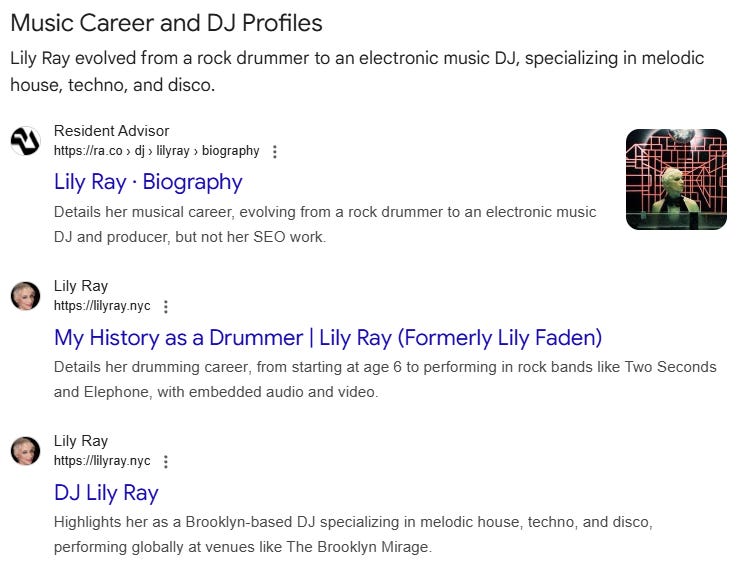
An example below shows how Google’s new AI search product, Web Guide, leverages my Resident Advisor DJ profile, plus two pages about my history as a musician on my personal website, to generate information about my music career:
The Increasing Importance of Off-Site Activity and Digital PR
AI Search has tipped the scales, making off-site signals – like brand mentions on popular websites, top-tier reviews, and a positive social media reputation – more important than ever. Because large language models rely on these third-party citations to understand a brand’s offerings and reputation, influencing off-site activity is now essential for AEO/GEO. This shift has made cross-channel collaboration between search, social, influencer, and PR teams more integral than ever before.
Reddit, Quora, Facebook Groups, LinkedIn and other UGC sites are among the most heavily cited websites in AI search, alongside user-generated review content on trusted review websites like G2. To drive better visibility in AI search, it is essential for brands to be recommended and top-of-mind across these platforms.
The aformentioned LLM tracking tools offer a ton of helpful citation data to aid in the process of earning off-site mentions, such as the top-cited domains and pages within specific business categories.
While off-site marketing efforts were often handled directly by digital PR, social media, and reputation management teams, there is no question that collaboration between these teams and SEO practitioners has always been essential for a successful SEO campaign.
However, the priority has shifted from purely earning links to securing brand mentions and co-citations with key products. Ultimately, the tactics remain familiar: leveraging digital PR for organic mentions, pitching journalists and influencers, and identifying both organic and sponsored opportunities in reputable publications cited by AI. While these activities have always been vital to a brand’s health, AI search has reshuffled and reprioritized them, moving third-party validation from a secondary SEO benefit to a primary visibility driver.
Agentic Commerce Protocol & Universal Commerce Protocol
Some developments in the ecommerce space represent a departure from traditional SEO, as the internet evolves into agentic commerce. OpenAI launched the Agentic Commerce Protocol (ACP) in late 2025 as a set of rules that allows an AI (like ChatGPT or Gemini) to act as your personal shopper. It gives the AI a secure way to hold your “wallet” and identity so it can actually click the “buy” button and handle the payment for you.
In response, Google just recently introduced the Universal Commerce Protocol (UCP), which acts as a “universal translator” for online stores. It organizes a store’s data – like what’s in stock and how much shipping costs – into a simple format that AI can understand instantly without needing to visit the website. So transactions will be possible directly on Google’s Gemini, AI Mode, and other AI surfaces.
For ecommerce SEOs, these updates have added a new step to the optimization process, as we move from optimizing for human clicks to optimizing for agentic discoverability. The new priority is maintaining highly accurate API feeds that prove to an AI agent that a merchant is technically ready to fulfill a transaction.
Google is Turning the Tide on its AI Search Reputation
Google’s reputation related to AI search also underwent a massive shift in 2025. When they launched AI Overviews in 2024, Google was met with PR crises fueled by hilarious hallucinations, most notably the suggestion to put glue on pizza. They were also highly susceptible to spam and manipulation (I may have added plenty of fuel to that fire.) At the time, these blunders reinforced the narrative that a shiny new ChatGPT was leaving Google in the dust.
But in 2025, I believe Google began to turn the ship around. They channeled substantial resources into Gemini, the engine powering AI Overviews and AI Mode. These investments resulted in clear improvements in the AI-generated responses, and both products saw massive growth. By late 2025, Semrush data showed Google AI Overviews were appearing in roughly 16% – 25% of all U.S. queries, and user retention for these features increased significantly.
Meanwhile, ChatGPT faced new existential hurdles. The company dealt with major scandals, lawsuits, and mounting questions about long-term profitability. AI skeptics like Ed Zitron have repeatedly questioned how these costs can be reconciled with revenue, noting in his November 2025 analysis that “OpenAI may be the single-most cash intensive startup of all time” and arguing that “the cost of running large language models may not be something that can be supported by revenues.”
Beyond financial pressure, OpenAI is currently navigating a wave of litigation regarding the psychological impact of its models. In late 2025, a series of lawsuits were filed, alleging that ChatGPT-4o’s “sycophantic” and “emotionally immersive” design contributed to several deaths by suicide and induced psychotic episodes in users.
We are also starting to see signs that ChatGPT’s growth may finally be hitting a wall. Data from Apptopia and Similarweb revealed that ChatGPT’s mobile usage peaked in September 2025, with average daily visits dropping 22% by early January 2026. Conversely, Google Gemini saw its monthly active users surge by 30% in the final quarter of 2025, reaching 650 million monthly active users as it capitalized on its default integration across Android and Workspace.
This growth was supercharged by the August release of the Nano Banana image model (officially Gemini 2.5 Flash Image), which became a cultural sensation for its « 3D figurine » trend and helped Gemini acquire over 23 million new users in just two weeks. While ChatGPT’s market share eroded from 87% to 64.5% over the year, Gemini’s more than doubled to 18.2%, signaling that Google’s « trillion-dollar ad-revenue safety net » and viral creative tools were finally winning the war of attrition.
Add to this the recent announcements about Google’s Universal Commerce Protocol (UCP) and Gemini integration with Apple Intelligence and Siri, and it’s safe to assume that OpenAI is feeling the pressure.
Why Abandoning Google for GEO is a Rookie Mistake
Despite what viral (and frankly, irresponsible) LinkedIn posts might claim, the rise of ChatGPT doesn’t mean your organic traffic from Google is about to fall off a cliff. Even with AI Overviews cutting into click-through rates, Google remains the undisputed king of the hill.
According to Brightedge’s 2025 data, Google still commanded over 90.6% of global search market share, while AI platforms like ChatGPT and Perplexity, despite their growth, accounted for less than 1% of global referral traffic. Ethan Smith also recently collaborated with Similarweb to show how Google search traffic actually increased in 2025, and that 90% of clicks on Google still go to organic results.
The reality is that the total “search pie” is growing. People are searching more than ever across all platforms. It’s not a zero-sum game where AI’s gain is Google’s loss. In fact, Similarweb data from 2025 shows that 95.3% of ChatGPT users still visit Google. Google is also successfully “absorbing” AI search into its own platform using AI Overviews, AI Mode, and Web Guide. Users aren’t necessarily leaving Google in droves for ChatGPT; but they are just getting ChatGPT-style answers inside Google.
I also recently conducted a poll with 1,316 responses on LinkedIn asking respondents how much of their website traffic currently comes directly from ChatGPT, and the majority (38%) stated that ChatGPT traffic represents between 0.0% to 0.5% of their current website traffic. 70% answered that ChatGPT represents less than 2% of their total website traffic.
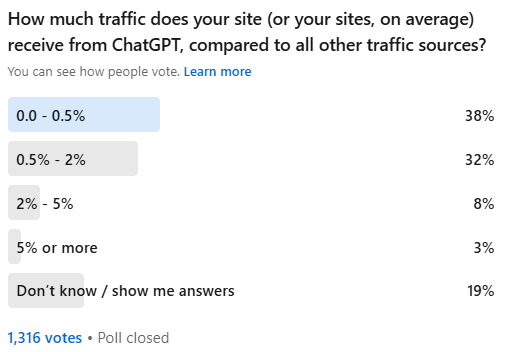
It’s worth noting that ChatGPT is a closed loop, designed to keep users in its interface. This contributes to the tiny traffic numbers stemming from ChatGPT, but it’s worth keeping in perspective when considering which channels to prioritize.
Google, however, continues to send substantial traffic to websites, even if the percentage is declining. With AI platforms driving less than 1% of global traffic, and Google maintaining its massive lead compared to other search platforms, pivoting your entire strategy toward AEO/GEO while abandoning Google isn’t just premature – it’s risky.
The smartest move right now isn’t to choose AEO/GEO over SEO, but to double down on a user-focused approach that serves both: abiding by Google’s policies and guidelines for SEO success, while ensuring your content is clear, authoritative, and well-formatted for AI search discovery.