Last updated on January 14, 2026. This article has been expanded since its original publication on November 20, 2025. Earlier versions may differ from what you’re reading today.
It’s that time of year when your LinkedIn feed gets flooded with reports, outlooks, megatrends, deep dives, and “future of travel” PDFs.
And let’s be honest: keeping up is nearly impossible.
So let me save you a few hours of scrolling.
📖
I’ve read and assessed nearly 50 major 2026 travel outlook reports (stopped counting at 37) and mapped the most relevant ones into a simple framework to make sense of the noise.
I call this framework The Insight Leadership Matrix (because every great framework deserves a fancy name 😉)
The framework has four quadrants, based on two dimensions:
- Research depth and quality
- Narrative strength (a.k.a. Attitude)
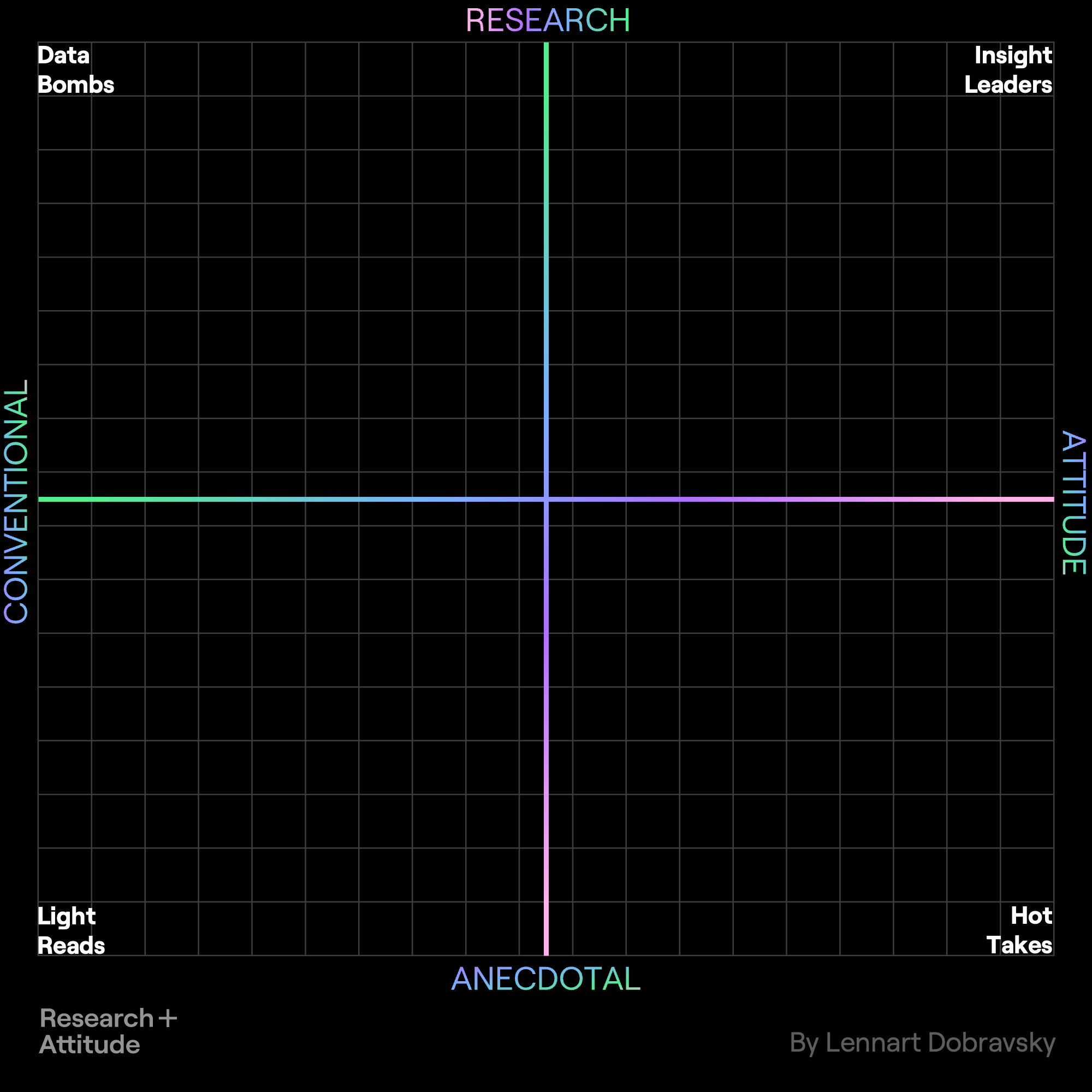
How I grouped the reports:
- Light Reads: These reports won’t offend anyone, and that’s kind of the point. Strong on destinations, prices, and traveler moods, but mostly descriptive rather than directional.
- Hot Takes: These are still relatively light reads (often thin on hard data), but they make up for it with sharper synthesis, bolder narratives, and more opinionated predictions. Less “what travelers already do,” more “where this might be heading.”
- Data Bombs: These reports are packed with charts and numbers. Strong on data grounding and objectivity, but lighter on narrative, synthesis, or strong points of view. The upside: lots of raw signal. The downside: the reader has to do more of the interpretive work themselves.
- Insight Leaders: The gold standard of trend reporting. This is where data stops being descriptive and starts driving insight. Strong evidence, clear synthesis, and the courage to take a stance.
So where did the 2026 reports land?
Below is my personal (and honest) assessment, intended to be constructive, not critical.
Below the visual, you’ll find a short breakdown of each individual report.
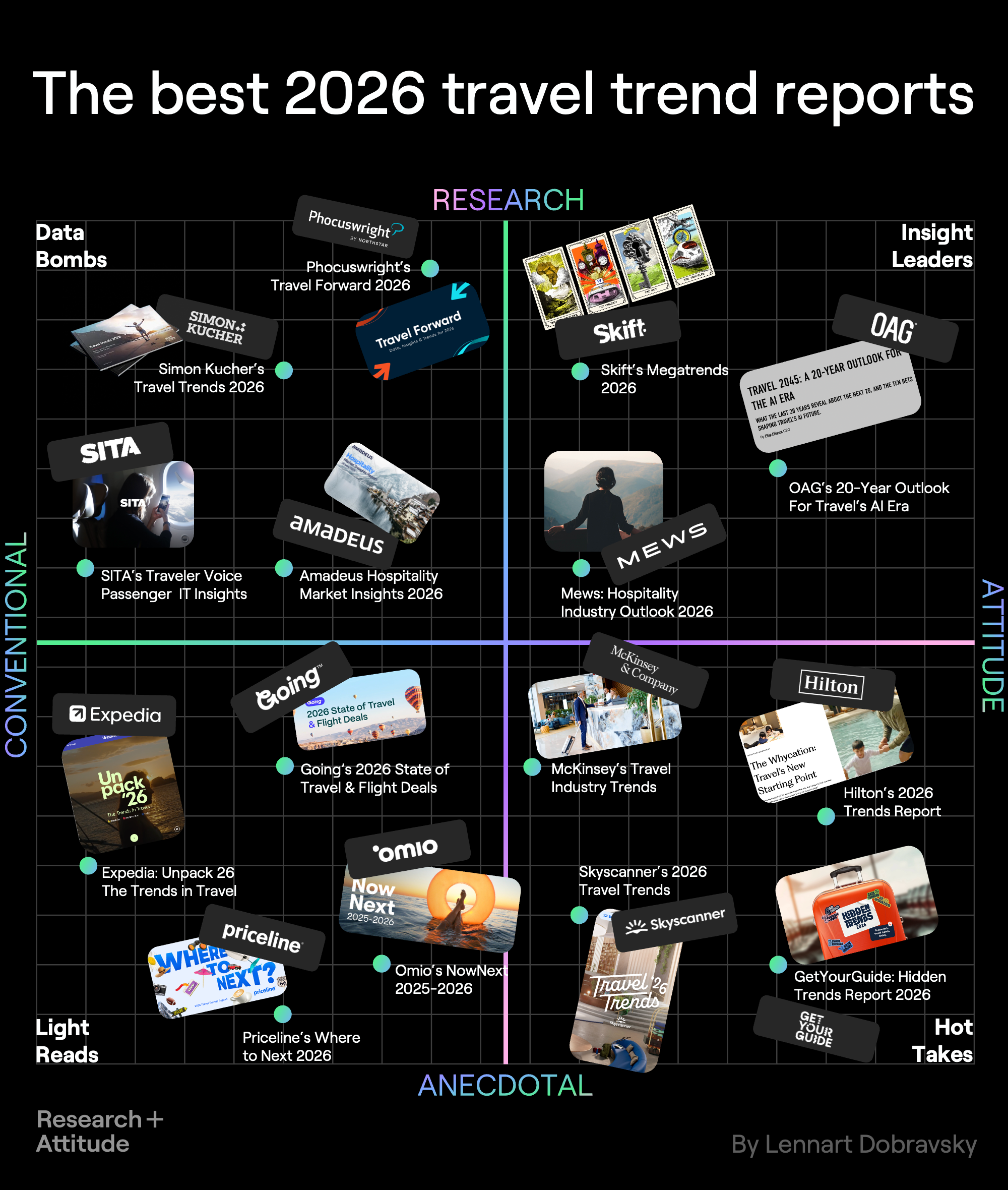
(1/4) Starting in the bottom-left quadrant (Light Reads)
1) Expedia: “Unpack ’26: The Trends in Travel”. A relatively data-rich, first-party look at how travelers will explore the world in 2026, from immersive slow-travel stays and sport-driven pilgrimages to “readaways” and multi-hotel trips (blending behavior, destinations, and emerging experiences). Read Report
2) Priceline: “Where to Next in 2026?” An industry outlook built on proprietary search and booking trends that leans into familiar travel narratives around “more trips, more destinations, more doing” (with spontaneous mini-getaways, emerging destinations, and AI-powered planning all in play). Read Report
3) Going’s 2026 State of Travel & Flight Deals. A deals-centric snapshot of where travelers are heading in 2026, focused on flight pricing signals, route trends, and deal availability rather than deeper behavioral shifts. Built primarily on aggregate deal and pricing data from the platform itself (which is nice). Read Report
4) Omio: “NowNext 2025–2026”. A fairly typical trend report with safe bets around the rise of “intentional travel”, so travelers who are planning more deliberately, combining transport modes, and prioritizing experiences over logistics. Read Report
(2/4) Over to the bottom-right quadrant (reads with more punch)
5) McKinsey‘s Travel Industry Trends. A classic McKinsey-style synthesis of macro trends shaping travel, framed through a private-equity lens. Polished, confident, and directional (though many insights will feel familiar if you’ve followed the sector closely). Read Report
6) Hilton: “2026 Trends Report”. A well-produced, brand-forward take on how travelers’ expectations are evolving (from experience-led stays to emotional and social drivers of travel). Strong storytelling, fewer surprises. Read Report
7) Skyscanner: “2026 Travel Trends”. A lively, consumer-facing trends piece built around search data and traveler intent. Optimistic, skimmable, and future-facing with clear themes, even if the depth remains limited. Read Report
8) GetYourGuide: Hidden Trends Report 2026. A refreshingly opinionated report that zooms in on emerging behaviors and under-the-radar experiences. More speculative than data-heavy, but one of the bolder attempts to spot what’s next, not just what’s popular. Read Report
(3/4) Next is the upper-left quadrant (Data Bombs)
9) Simon Kucher: Travel Trends 2026. A dense, survey-heavy deep dive into traveler price sensitivity, willingness to pay, and value perception. Excellent if you want numbers to work with, but less helpful if you’re looking for a bold narrative or strategic stance. Read Report
10) Phocuswright: Travel Forward (Data, Insights & Trends for 2026). A very comprehensive, data-first outlook spanning demand, distribution, technology, and traveler behavior. Extremely useful as a reference deck, but more of an analytical compendium than opinionated insight leadership. Read Report
11) SITA: “Traveler Voice Report”. A global survey-driven snapshot of passenger attitudes toward airports, airlines, biometrics, and digital services. Rich in quantitative insight but largely leaves the “so what?” to the reader (so take some time to digest it yourself). Read Report
12) Amadeus: Hospitality Market Insights 2026. A very solid, data-packed overview of global hospitality performance, demand drivers, and operational trends. Very strong on market mechanics and benchmarks, lighter on interpretation or forward-leaning thesis. Read Report
(4/4) And finally, the upper-right quadrant (rich in data and interpretation – my favorites!)
13) Mews: Hospitality Industry Outlook 2026. One of the most unconventional approaches in this year’s trend season. Instead of starting with raw data alone, Mews builds its outlook around a structured expert-panel methodology: surveying 18 industry experts across multiple future scenarios and systematically quantifying likelihood, impact, and desirability. The result is a thoughtful, scenario-driven synthesis on how tech could reshape the guest journey from search to stay (and what hotels need to do to remain competitive). The trade-off: it’s deeply hotel-centric, so insights don’t fully translate to the wider travel ecosystem. Read Report
14) Skift: Megatrends 2026. Skift at its best: a sweeping, ambitious attempt to map 19 structural forces reshaping travel, from luxury concentration, sustainability fatigue, and AI-driven distribution shifts to flying taxis, autonomous mobility, experiential retail, and new forms of tourism demand across Africa and Asia. The breadth is impressive, and the editorial storytelling is strong. Two caveats stand out. First, several megatrends are explicitly sponsored by Skift clients, which makes it harder to fully separate objective trend conviction from commercial agenda (understandable given the scale of the project, but still something to read with a critical eye). Second, despite Skift’s deep research capabilities, much of the evidence feels more narrative-led than data-led (though that may also reflect my own data obsession). In any case, definitely amongst the most thought-provoking reads in this set. Read Report
15) OAG: A 20-year outlook for Travel‘s AI era. A deliberately long-horizon outlook that refuses to play the usual one-year trend game. Instead of predicting “what’s hot next,” OAG lays out 10 very concrete bets on how AI could reshape travel technology over the next two decades (including some contrarian takes, such as AI adding back serendipity to enrich travel experiences). One of the most intellectually ambitious reads in this set, authored by OAG’s newly appointed CEO Filip Filipov, whose recent Web in Travel keynote many (myself included) found refreshingly concise, no-bullshit, and data-driven. Read Report
If I missed any report, let me know. Send me an email at lennart@onechart.co or leave a comment on LinkedIn.
💡