A Practical Guide To Get You Up and Running
Yesterday was a big day for Agentic Commerce.
Sundar Pichai, Google’s CEO, came in person to the NRF conference in New York City to present the Universal Commerce Protocol (UCP), launched by Google together with a broad set of partners.
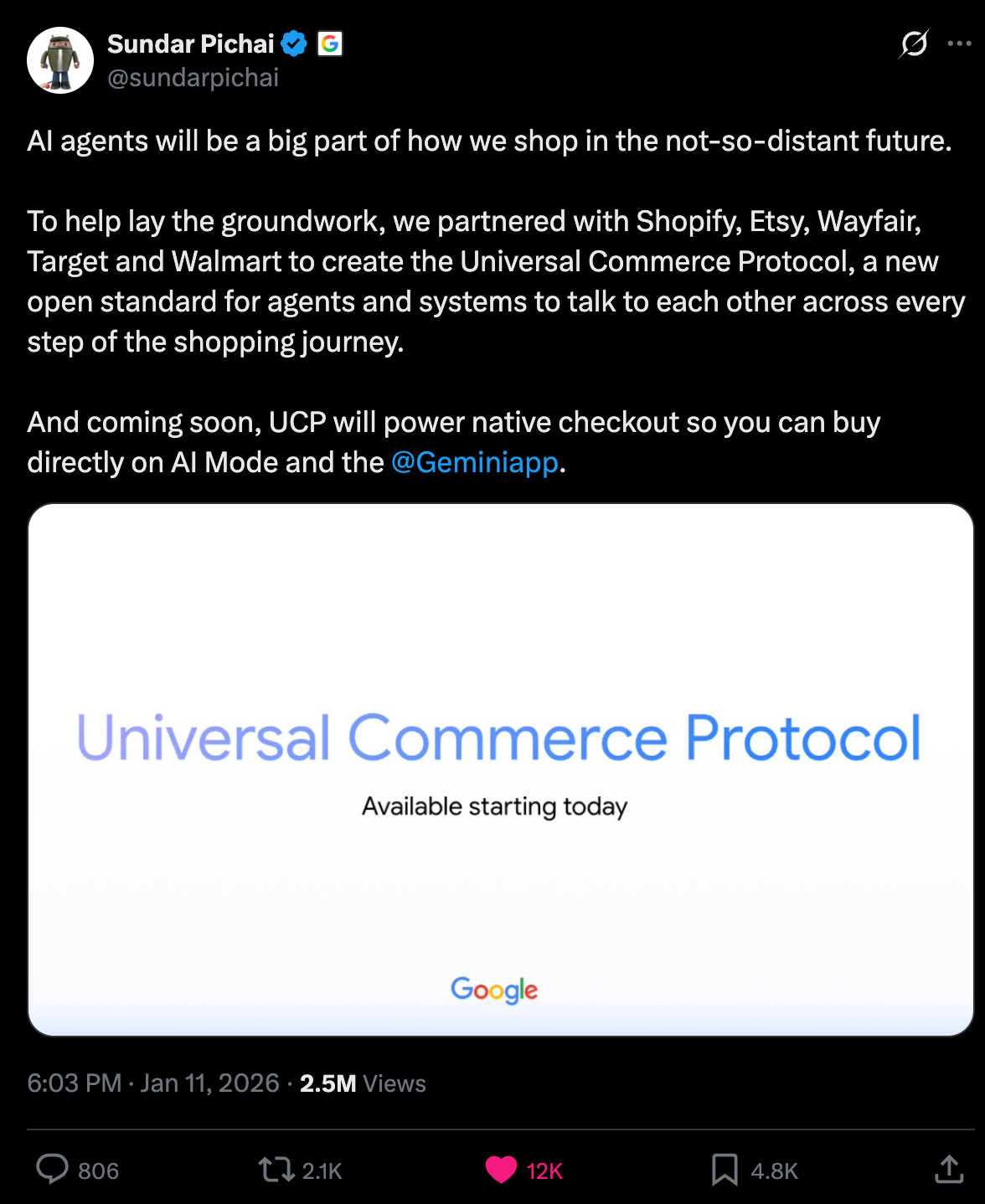
This is effectively Google’s answer to OpenAI Instant Checkout and the Agentic Commerce Protocol (ACP), which was announced in late September 2025. With this announcement, Agentic Commerce moves from a concept into a real standards battle – a fight over which protocols will define how agent-driven commerce actually works.
These are the main partners for Google’s UCP:
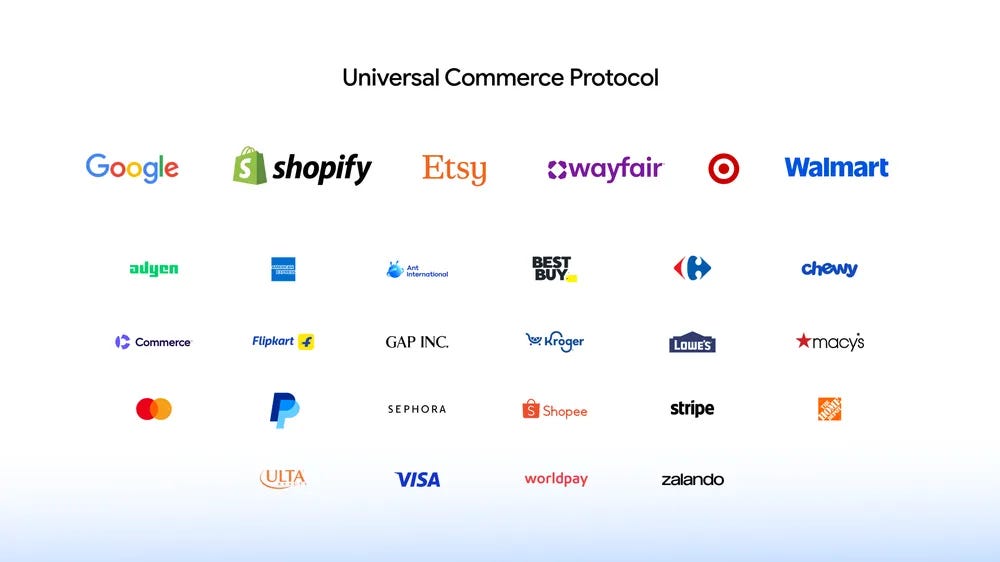
UCP is highly ambitious. It is also tangled in a lot of technical jargon, specs, and adjacent announcements that can make it hard to separate signal from noise. Some parts of the announcement are not even directly related to commerce flows themselves but rather to ads and other things.
The goal of this post is simple: explain what UCP actually is, what it means in practice, and clarify what is really happening. No hype.
Structure of this post:
-
TL;DR – what should we know about UCP
-
Core differences between OpenAI’s ACP and Google’s UCP
-
Market dynamics
-
UCP roadmap
-
Some predictions
-
What’s next
-
Resources
We’ve included links to the relevant technical resources and announcements below for convenience.
We will be covering more developments in agentic commerce in depth throughout the year. Feel free to follow if you want to stay updated.
1. TL;DR – the basics
What is UCP?
At a basic level, UCP is the protocol that will be powering commerce inside Gemini and Google AI Mode.
Users will be able to search for products within the Gemini or Google AI Mode interface, see product cards, and complete checkout directly. The application (e.g. Gemini) includes a wallet that stores payment credentials, currently based on Google Pay.
How merchants connect
Merchants that want to sell through these surfaces integrate via Google Merchant Center, which already powers Google Shopping. Many merchants are already onboarded, with product catalogs and structured data in place. For the checkout, merchants will need to implement an agentic checkout service and connect it to their existing infrastructure. Shopify (which is a main contributor to UCP) announced that it will support it natively. More on checkout below.
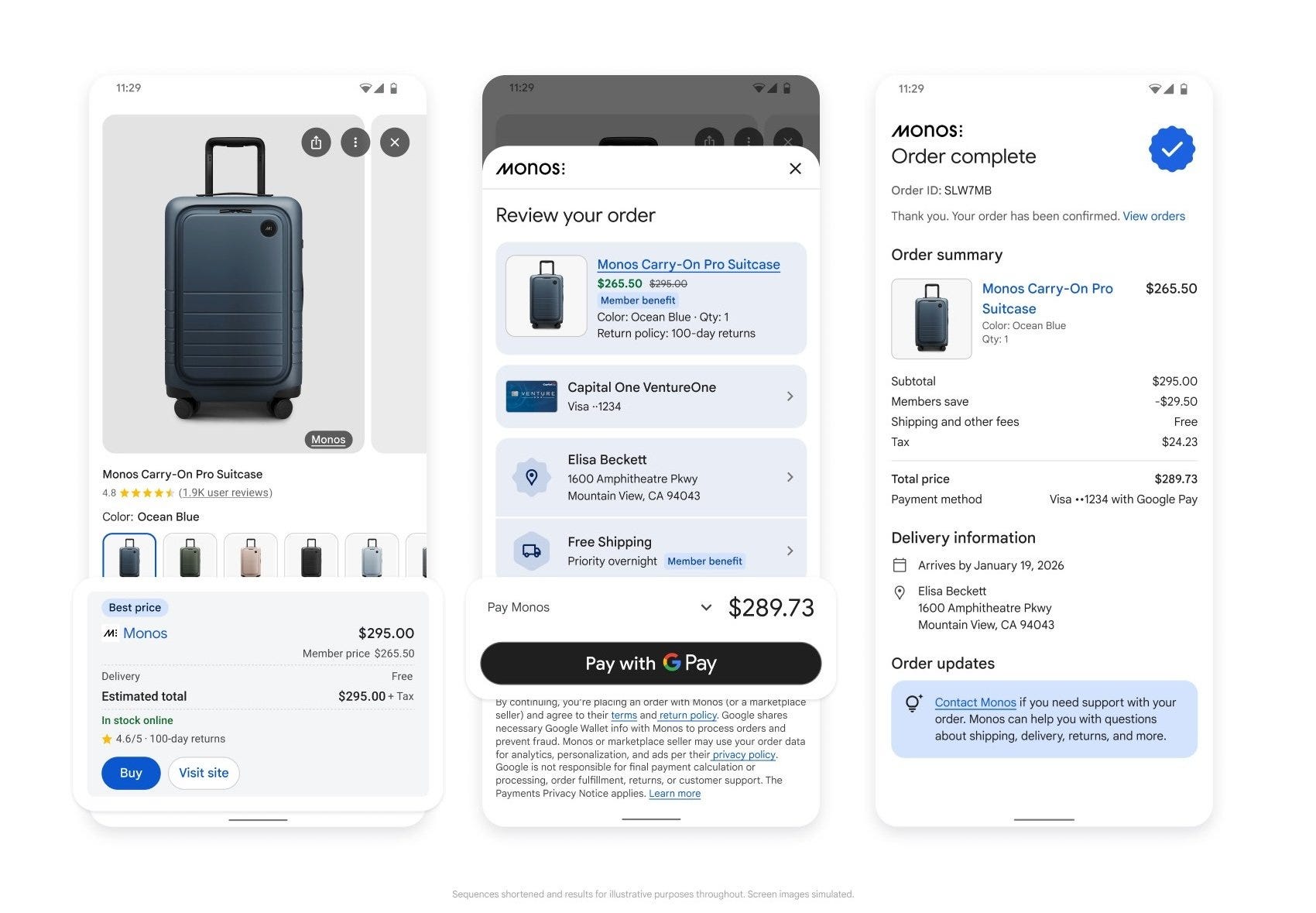
To make catalogs more usable by LLMs, Google introduced many new product attributes, so merchants will need to enrich their product data (they might have a product feed connected to Google Shopping but optimized towards keywords). Unlike keyword search, LLMs rely on richer context, so these attributes improve discovery and relevance.
Scope: Google-first, but designed for more
Although UCP powers Gemini and Google AI Mode, the protocol itself is general purpose. It is designed to connect many merchants to many agents (NxN), not just Google’s, and includes built-in discovery so agents can find merchants.
In practice, what most people will see in 2026 is merchants selling directly inside Gemini and Google AI Mode, with the option for those same merchants to sell across other agentic channels (we predict that there will be a significant gap this year between the futuristic promises of UCP and what consumers actually end up using in practice, which will be mostly the ‘Buy Now’ button on Gemini/Google AI Mode).
Checkout mechanics
From a checkout perspective, UCP shares the same core concepts as OpenAI’s ACP Instant Checkout. If you understand ACP, you will largely understand UCP’s buy-now flow.
Payment credentials are sent to a processor, tokenized, sent back to the AI platform/agent, and passed to a checkout gateway that integrates with existing merchant systems.
UCP is agnostic to the payment processor and merchant’s underlying commerce tech stack, plus like OpenAI, the merchant remains Merchant of Record. Just like OpenAI, the AI platform/agent is not in the payment flow (they just orchestrate the process of generating the payment token and relaying it to the merchant via some agentic checkout API).
There are important differences and extensions – Gemini requires a different checkout implementation, even though the underlying concepts remain the same. Google also benefits from its existing Merchant Center infrastructure, which gives it a strong strategic advantage as a lot of merchants already have integrations in place (hard to overstate this point – maybe the most important in this post. We wrote more about the strategic implications below.)
UCP is designed to be ambitious and future-facing. It is intentionally agnostic to other Google efforts like A2A or AP2, even if those are not yet really used in practice. It also introduces components not present in OpenAI’s ACP, most notably agent-to-merchant authentication, which may become relevant for agents implementing the protocol.
2. Core Differences Between OpenAI ACP and Google’s UCP
At a very basic level, both UCP and ACP power the same surface: a Buy Now button inside AI interfaces – ChatGPT for ACP, and Gemini and Google AI Mode for UCP. From that perspective, they are solving the same problem and enabling the same core user experience on different AI platforms.
Where they diverge is in design philosophy.
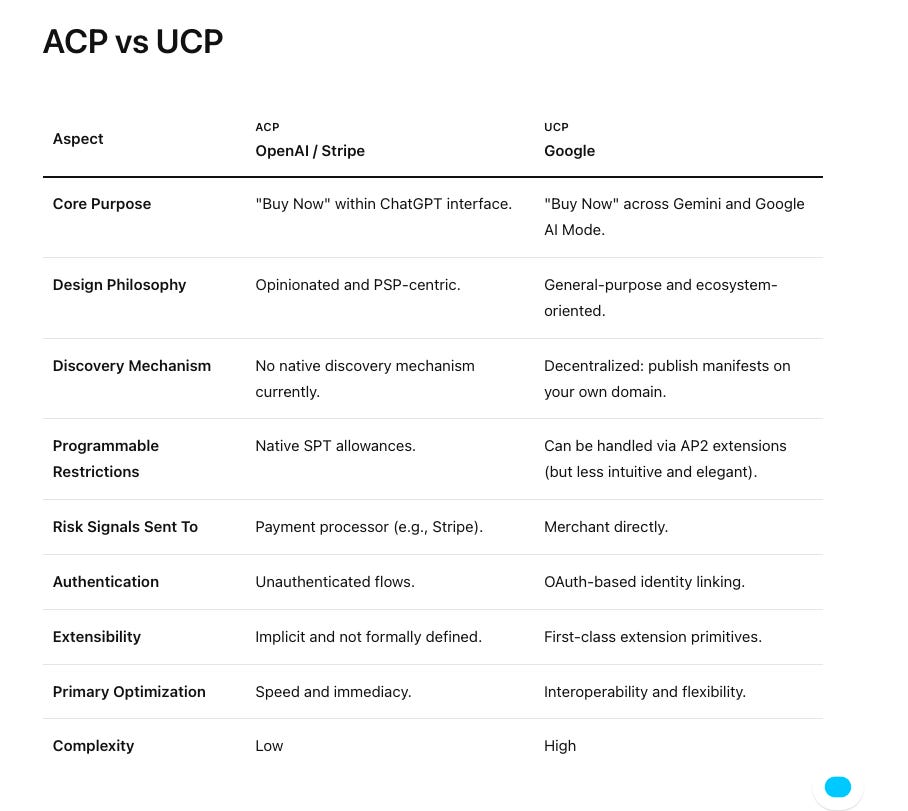
Google’s UCP is significantly more general purpose. That is the first major difference. ACP, built by OpenAI together with Stripe, is highly OpenAI-centric and payment-processor-centric. It is tightly scoped, opinionated, and optimized around Stripe’s role in the flow. UCP is designed to be more decentralized and ecosystem-oriented.
This is most obvious in discovery. ACP has no native discovery mechanism (i.e. how agents find out about merchants and their exposed capabilities and vice versa). Today, merchants that want to appear in ChatGPT go through a centralized OpenAI-controlled listing process. With UCP, merchants can (in theory) publish their commerce capabilities directly on their own domain. Agents can then discover merchants without relying on a single centralized gatekeeper. Even though the initial application is similar (ChatGPT/Gemini), the underlying architecture is fundamentally different.
This does not mean OpenAI will not evolve in this direction. And to be clear, merchants that want to sell on Gemini will still go through Google Merchant Center, so decentralized discovery is less relevant in practice today.
OpenAI shipped tightly engineered, well-defined specifications first. Google introduced broader, more ambitious systems from day one, often with more jargon and future-facing abstractions.
There are also several concrete technical differences –
Both protocols are agnostic to payment processors and wallets like Google Pay or Apple Pay. But in practice, ACP is more payment-processor-oriented. The Shared Payment Token generated by Stripe in ACP supports programmable restrictions, called allowances in ACP. These allow fine-grained limits and controls (so a user can decide that a payment credential will have restrictions like 24 hours expiry and other specifics). UCP does not have an equivalent concept baked in. Similar behavior could be constructed using AP2, the previous payment standard that Google issued, but it is more complex and less elegant than ACP’s native approach (it requires cryptographic signatures and a fancier, more complicated tech stack, rather than simply the as-a-service approach of the Stripe implementation).
Risk signaling is another difference. In ACP, risk signals are sent only to the payment processor, Stripe. In UCP, risk signals are sent directly to the merchant, which aligns better with how merchants operate today, since they typically use their own fraud and risk vendors.
Authentication is also missing in ACP. Instant Checkout today is unauthenticated. UCP, by contrast, allows merchants to define OAuth-based authentication so agents can interact with merchants in an authenticated way (we are not sure this difference will surface on OpenAI vs. Gemini, because in both you are authenticated within the session. But it is relevant for another third party agent that wants to communicate with a merchant, and needs some auth mechanism).
Both protocols keep merchants out of PCI scope, which is an important shared property.
The key takeaway is this: ACP is optimized for speed and immediate deployment. It is simpler, more opinionated, and easier to reason about. UCP is optimized for ecosystem-wide interoperability and long-term flexibility. Both solve the same core problem – enabling AI agents and applications to complete purchases – but they make different trade-offs between simplicity and extensibility.
3. Market Dynamics
In both cases, OpenAI and Google followed a strategy we like to call:
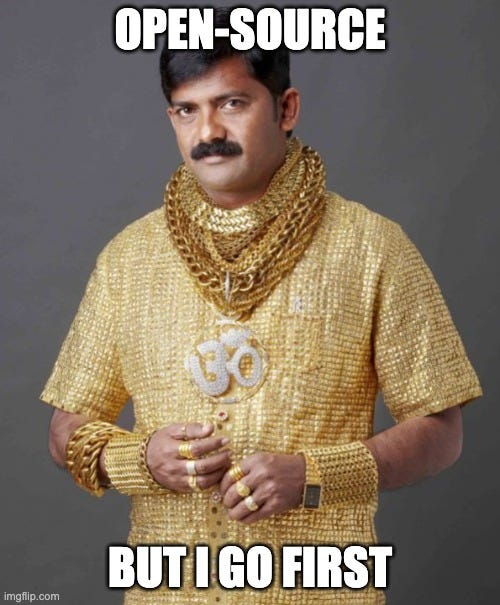
“open-source, but I go first.”
They released a protocol, but in practice they power themselves first – plugging it directly into their own AI platforms and existing business infrastructure, like OpenAI’s platform, Google Pay and Google Merchant Center.
This helps explain why ACP is more payment-processor-oriented, while Google’s approach is more decentralized and forward-looking. With greater scale and existing capabilities, Google can afford to design further ahead rather than optimize only for immediate execution.
A key advantage for Google is Google Merchant Center (hard to stress how much).
There is a major bottleneck in agentic commerce today: product catalogs. Getting SKUs deployed, kept up to date, and enriched is a massive operational effort for merchants, even before any protocol is implemented. This is much harder than it looks, and many merchants are already struggling with it (friend of the blog Scot Wingo writes a lot about this issue in Retailgentic).
Google already solved much of this. Product feeds exist, integrations are in place, and millions of SKUs, brands, and retailers are already onboarded. Even if the feeds are not yet as rich as what was just announced, the foundation is there. That makes the path from protocol to a working version much shorter.
OpenAI does not have this advantage. They need to build commerce infrastructure, teams, and merchant integrations largely from scratch. That gap could easily translate into months or years.
Short term, this means Google is more likely to reach real commerce scale with UCP, Gemini, and Google AI Mode in 2026. OpenAI will need to compensate by moving faster on the protocol and offering very attractive terms to merchants (we’ve written in our last post about how AI platforms will enter the ‘attract’ phase and compete over merchants and businesses).
Agentic commerce is moving from a single-player environment (OpenAI) into a space race. Platforms will compete to attract merchants, and merchants who move early are likely to benefit from better economics and stronger positioning in agent-driven commerce.
It will be interesting to see Meta’s and Anthropic’s moves in the space. Will they adopt ACP/UCP? Will they build something new? We bet there will be a response in 2026.
Direct Offers
Another announcement which was made was Direct Offers, which, to our understanding, is not a core UCP feature.
This is effectively the start of an ads and promotion layer on top of AI platforms. Merchants will be able to send targeted offers to users based on search intent, including searches for competitors’ products.
For example, if a user searches for a specific Nike shoe, Adidas could surface a direct offer for a comparable Adidas shoe at a discount.
This matters because upsells and promotional offers will likely become a major force within UCP over time. We will cover this more in the roadmap below, but this announcement represents the first concrete step in that direction. It is likely still experimental, but it signals where the platform is heading.
4. UCP Roadmap
Google published the UCP roadmap on the official UCP website. These are the main items they mentioned:
-
Loyalty and member benefits
Standardized management of loyalty programs and rewards.
-
Native cross-sell and upsell
Enhanced signals for personalized product discovery.
-
Product discovery and post-order management
Support the full commerce lifecycle, optimizing for lifetime value rather than single transactions.
-
Cart and basket building
Native multi-item checkout with support for promotions, tax, shipping, and complex fulfillment logic.
5. Our Predictions
Based on our initial analysis, we make some guesses about what’s coming this year:
-
Google advantage and faster scale
-
Google will have a major advantage by leveraging Google Merchant Center, especially existing product catalogs.
-
This will put Google significantly earlier to market than OpenAI in terms of GMV (although Gemini has a smaller user base).
-
Buy Now flows will reach meaningful scale, likely billions of dollars in purchasing volume in 2026.
-
-
Faster-than-expected ads expansion
-
Google’s ad business on AI surfaces will move much faster than most expect.
-
Direct offers and promotional placements will become a core monetization layer.
-
-
OpenAI accelerates ACP
-
OpenAI will be forced to speed up.
-
Expect ACP to open up significantly, with more partners, startups, and incentives for merchants (maybe even rewards or loyalty points to attract consumer spending).
-
The ecosystem around ACP will become more attractive because this is strategically critical for OpenAI.
-
-
Direct offers in ChatGPT
-
We expect an equivalent of Direct Offers to appear in ChatGPT in 2026.
-
-
Protocol leapfrogging
-
UCP and ACP will begin leapfrogging each other.
-
Features introduced in UCP, such as authentication and discovery, will quickly appear in ACP in some form.
-
6. What’s next
The space race for agentic commerce has begun.
Every merchant now needs to decide when and how to onboard – whether on Google’s UCP, OpenAI’s ACP, or both. These decisions will shape distribution, economics, and visibility across AI-native shopping surfaces in 2026.
If you are building your agentic commerce strategy for 2026, feel free to reach out to us at founders@nekuda.ai. We offer turnkey ACP and UCP implementations that let you connect and sell directly on AI platforms with minimal integration effort.
We will continue writing about major developments in agentic commerce. Subscribe below to stay up to date.