Two Reports, Two Realities: Everyday AI Use vs. Labor Market Transformation
Yesterday brought a rare moment of synchronicity in the AI world. Both OpenAI and Anthropic released major research studies that open a window into how their platforms are being used at scale.
Its important to note that while the studies are being directly compared, they are not symmetrical – OpenAI analyzed only consumer ChatGPT conversations (free + paid individual plans), while Anthropic combined Claude.ai transcripts with enterprise/API traffic, giving a richer view of workplace adoption.
Put together, they show two sides of the same adoption curve. OpenAI highlights consumer mainstreaming. Anthropic spotlights enterprise automation. Think of it as two camera angles on the same film: OpenAI’s wide shot of everyday people experimenting with ChatGPT, Anthropic’s close-up of businesses embedding Claude into their workflows.
OpenAI: Consumer Mainstreaming
OpenAI’s study based on 1.5M anonymized consumer conversations, is the largest dataset yet on ChatGPT’s personal use.
Key insights:
-
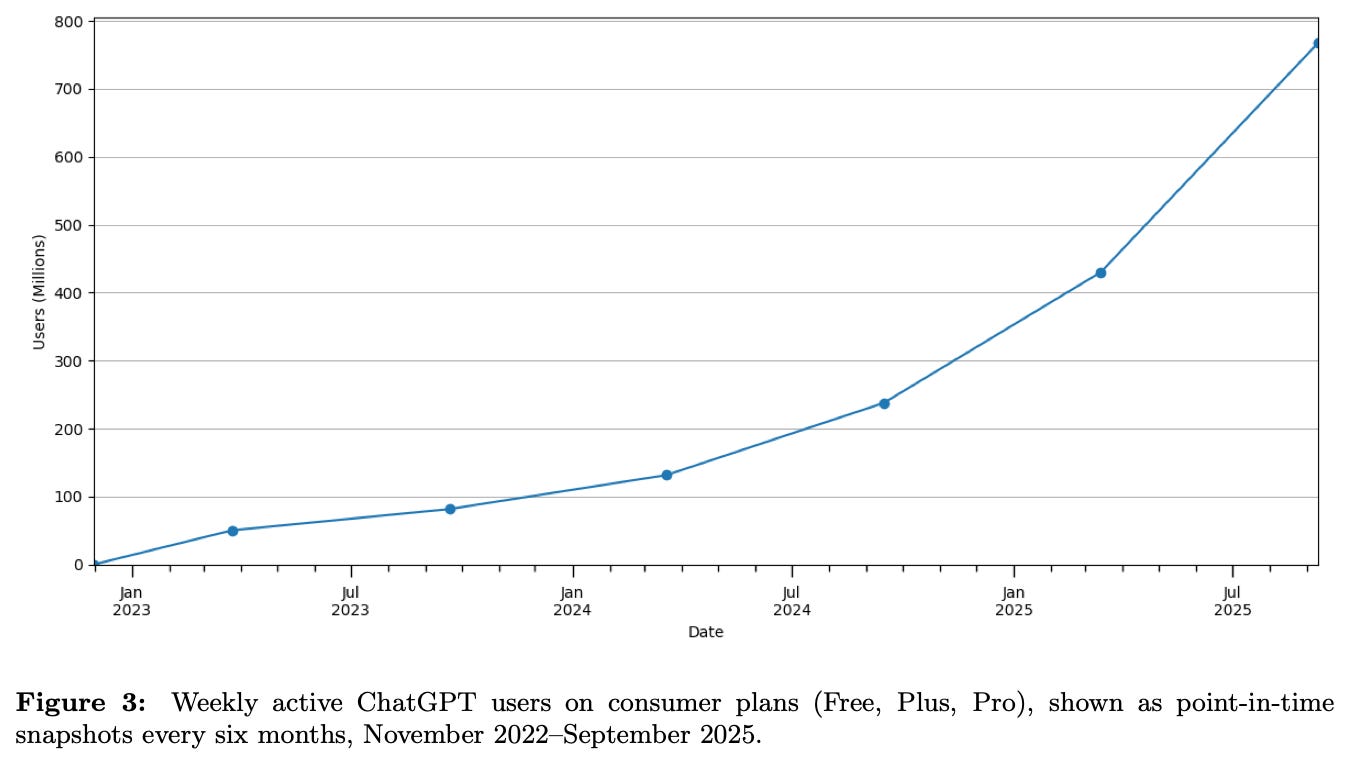
Unprecedented scale: From its November 2022 launch, ChatGPT grew to 1M users in 5 days, 100M WAU in one year, and nearly 350M in two. By Jul-25, it hit 700M WAU – almost 10% of the world’s adult population.
-
Demographic broadening: The early gender gap has closed – female-identifiable users rose from 37% (Jan 2024) to 52% (Jul 2025). Adoption in low-income countries has grown 4x faster than in high-income ones.
-
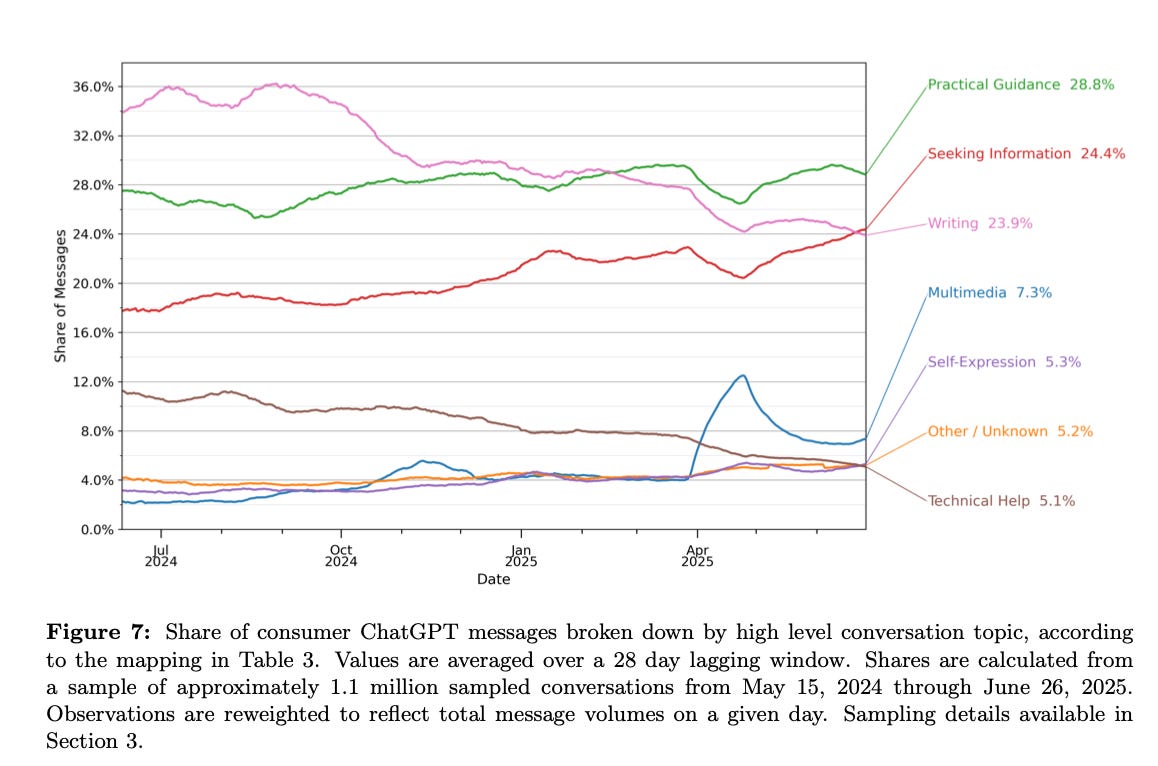
Everyday focus: Non-work usage now accounts for ~70% (vs. ~53% in early 2023). 3 categories dominate – Practical Guidance, Information-Seeking, and Writing – together 75–80% of all conversations. Coding and self-expression remain niche.
-
Interaction style: 49% asking (“What should I do?”), 40% doing (“Write this for me”), 11% expressing (“Here’s what I think”). ChatGPT is less a pure content generator than a decision-support engine.
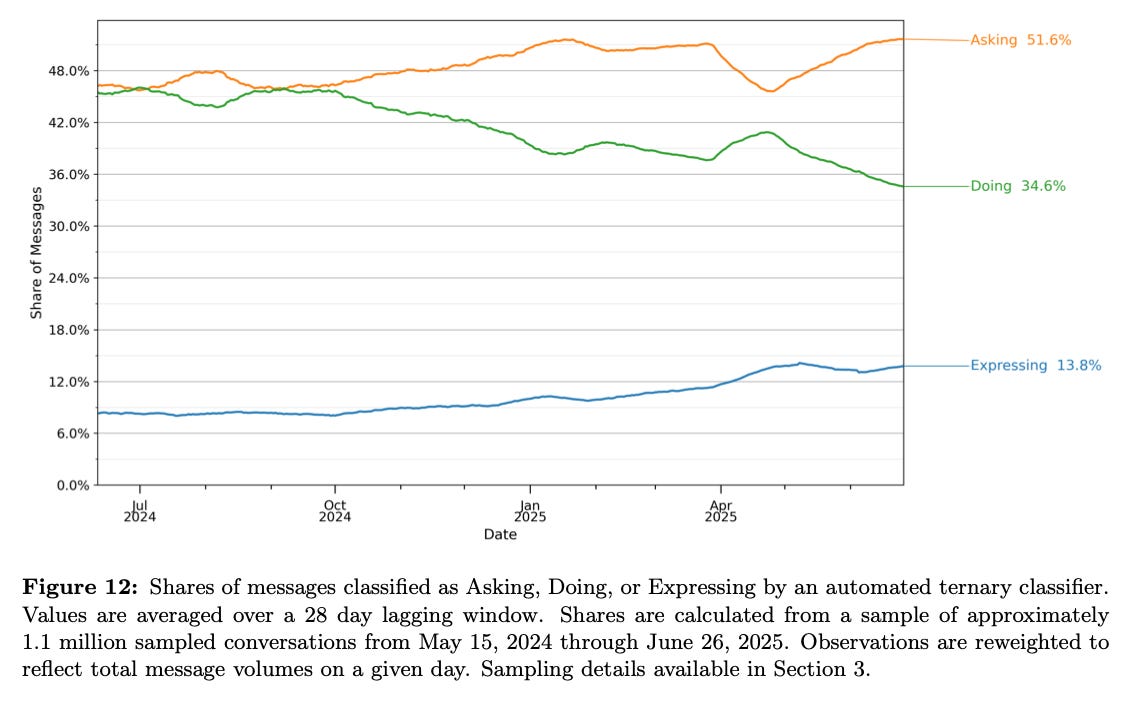
OpenAI’s data underscores ChatGPT’s status as a mainstream consumer utility for everyday problem-solving – broadly distributed, deeply embedded, and still expanding.
Anthropic: Enterprise Automation
Anthropic’s “Economic Index” report draws from ~1M Claude.ai conversations (Aug 2025) plus enterprise/API usage, making it the first large-scale window into business adoption.
Anthropic also highlights the breakneck adoption curve: in the U.S., 40% of employees now report using AI at work – double the share from just 20% in 2023.
Key findings:
-
Automation rising: This is the finding that has dominated headlines – and stoked fears of labor displacement.
Anthropic distinguishes two modes of interaction:
-
Automation = task completion. Users hand off work for Claude to do with little back-and-forth. This includes directive use (full hand-offs) and feedback loops (light corrections).
-
Augmentation = collaboration. Users work with Claude iteratively – asking it to explain, validate, or refine their own work.
Seen through this lens, the past year marks a turning point. On Claude.ai, directive conversations climbed from 27% in late 2024 to 39% by Aug 2025, driving automation to overtake augmentation for the first time.
API customers are even more automation-heavy: 77% of API conversations show automation patterns. What began as a collaborative tool is tipping into direct task automation.
-
-
Shifting task mix: Coding still dominates (36%), but education (9.3% → 12.4%) and science (6.3% → 7.2%) are growing shares. More requests to generate complete programs (+4.5pp) vs. debugging (-2.9pp) suggest higher trust in Claude’s outputs.
-
Geographic skew:
Anthropic’s Usage Index (AUI) measures adoption relative to a country’s population. A score above 1.0 means heavier-than-expected usage per capita; below 1.0 means under-adoption. The results are highly uneven. Singapore (4.6x) and Canada (2.9x) punch well above their weight, while India (0.27x) and Nigeria (0.2x) trail far behind. Interestingly, low-adoption countries skew toward automation-heavy patterns, while high-adoption regions show more diverse, augmentation-driven use (education, science, business). Within the U.S., DC (3.82x) and Utah (3.78x) actually outrank California (2.13x) and use-cases in each reflect local economic strengths (finance in Florida, IT in California, career services in DC). -
Price insensitivity: API customers pay by the token, not by subscription. The most frequent tasks are also the costliest, yet still dominate usage. Anthropic’s interpretation: capability matters more than cost. When automation directly displaces or accelerates labor, enterprises show weak price sensitivity – suggesting strong monetization potential.
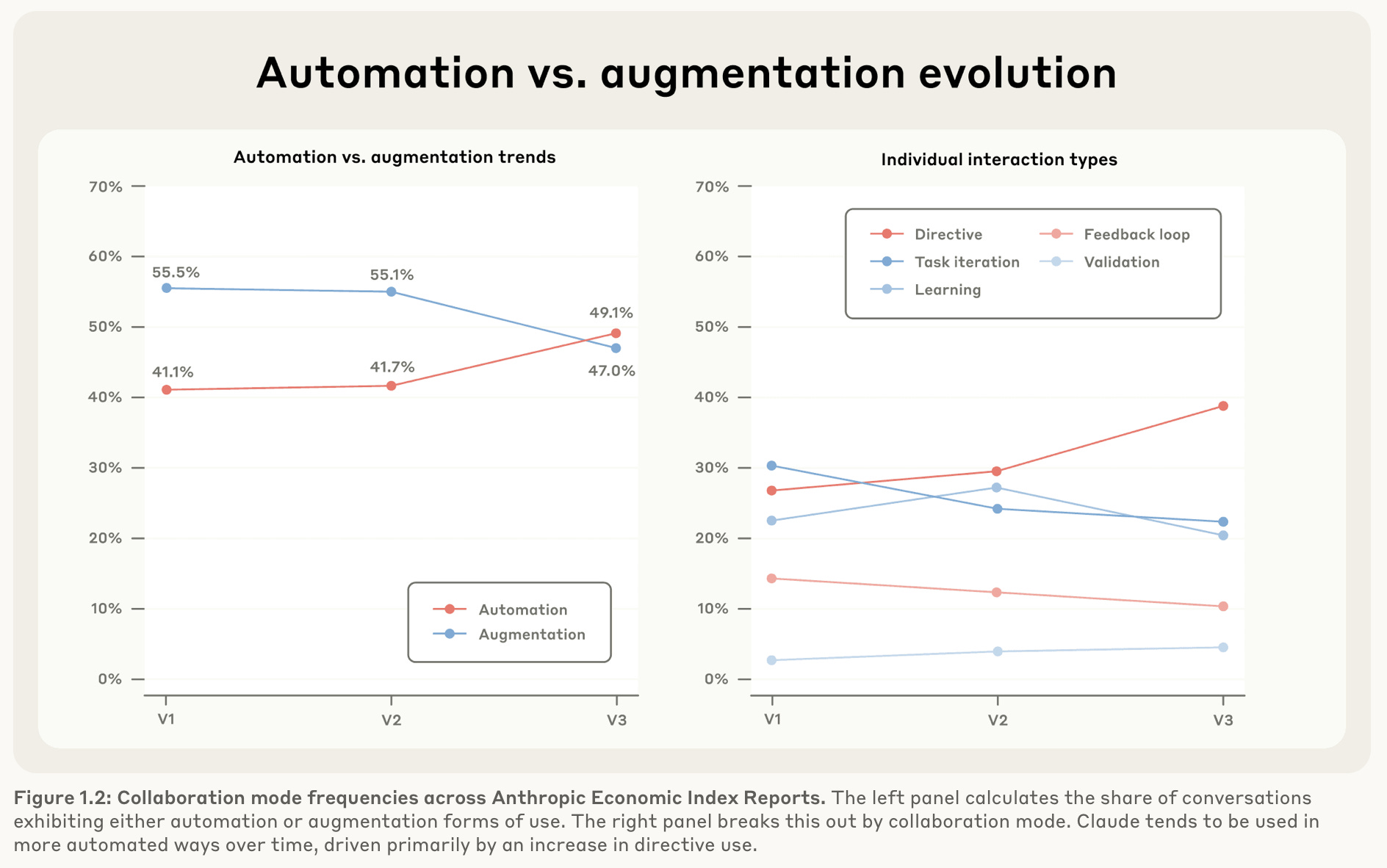
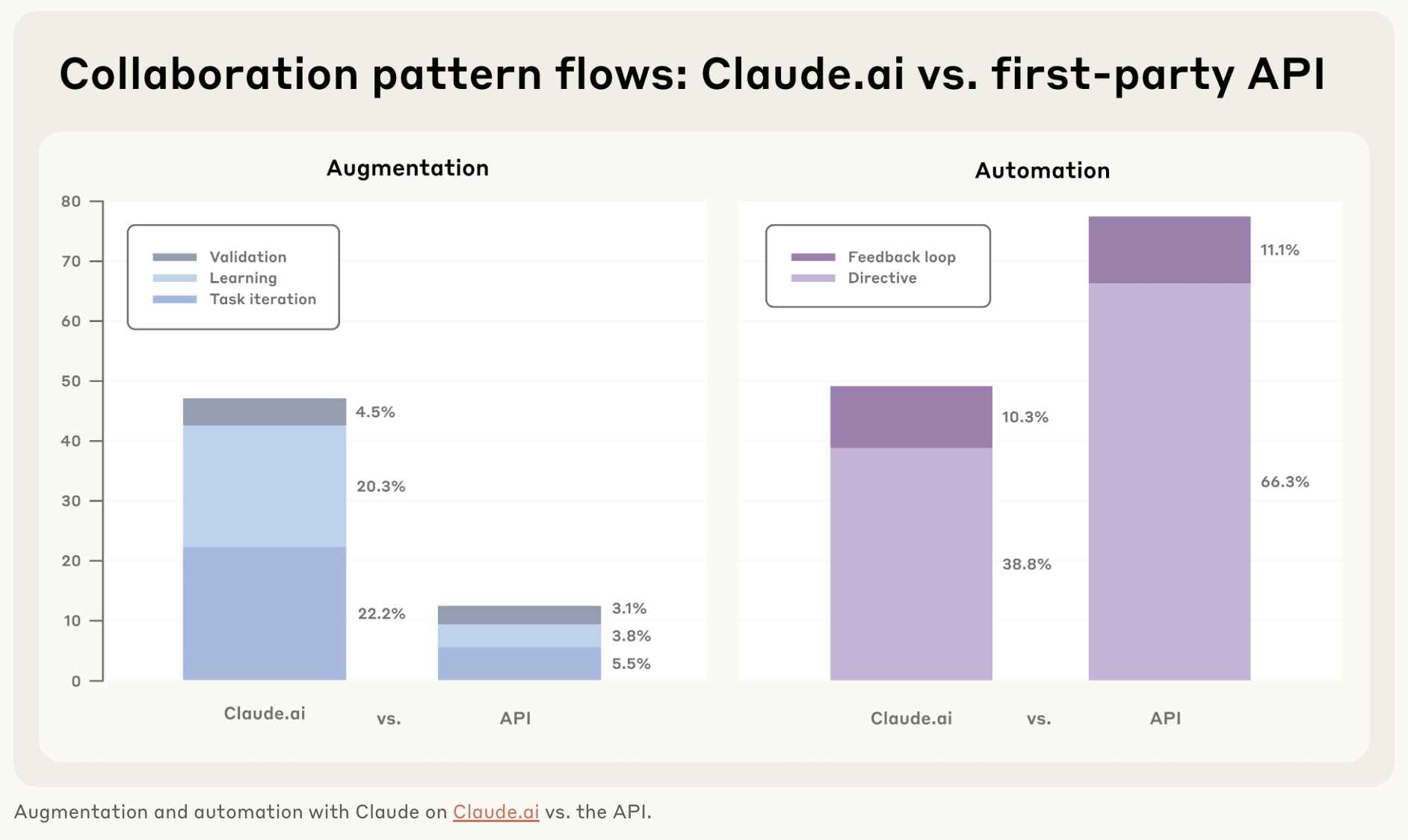
Anthropic’s data signals that enterprise AI is tilting toward automation at scale – a pattern historically linked with productivity leaps and structural economic change.
Two Views, One Trajectory
OpenAI and Anthropic’s studies offer different vantage points but converge on a shared theme: AI is no longer niche. For consumers, ChatGPT is a mainstream utility woven into daily problem-solving. For enterprises, Claude is shifting from collaborative augmentation toward direct automation, foreshadowing deep structural changes in work.
One lens shows ubiquity, the other efficiency. Together, they chart the dual paths by which AI is embedding itself into modern life – shaping not just how we work, but how we think, learn, and decide.