DISNEY’S LOST BILLIONS
Last year, I predicted that in 2026, mainstream Media would lean into the platforms and practices of the Creator Economy.
Last week, the BBC made my prediction true (it’s only January!), announcing a landmark deal with YouTube. They will not be the last.
Because, get this, YouTube IS TV now.
EVEN BEFORE the BBC announcement, I had embarked on a research project with my fiends at Merzigo to model out what traditional publishers and producers ARE MISSING by not better exploiting their catalogs on social video.
As a case study, we decided to quantify how much potential cash The Walt Disney Company leaves on the table, every year, by NOT unlocking their library content, for free with ads, on #YouTube.
Our process & results:
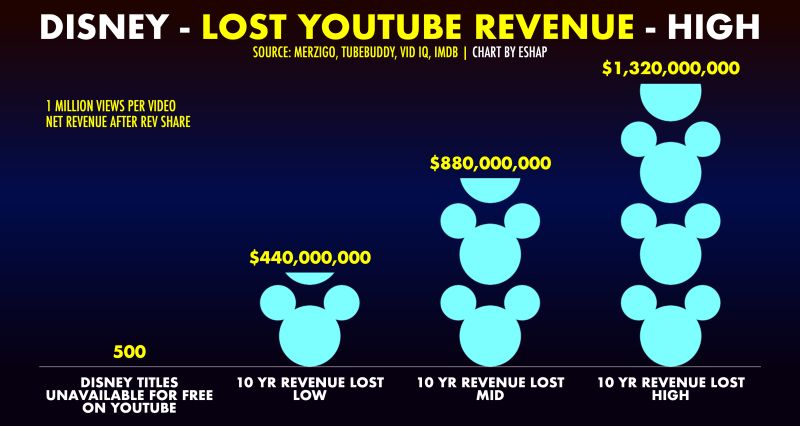
🐭 There are more than 500 Disney films on YouTube for purchase & rental. None are available for free with ads.
🐭 RMPs (aka CPMs) on YouTube for premium content, especially feature films from publishers like Disney, range from $10-$30. Films in YouTube’s Movies & TV section get RPMs on the high end.
🐭 While growing in popularity, Movies & TV is perhaps the most under-exploited content monetization outlet in Media.
🐭 YouTube is, by far, the world’s largest video channel. We can assume these Disney titles would be viewed tens of millions of times if available for free on YouTube. It is reasonable, if not conservative, to estimate the Disney film catalog would average 3M views per year/per title.
🐭 Disney Streaming CAN generate $30 RPMs for their content if they chose to sell it. First, it’s Disney. Second, they are very good at selling digital inventory.
🐭 In that case, I project, on the low end, Disney would generate $44 million per year, $440 million NET REVENUE over the next decade, from this effort. On the HIGH end: $132 million in NET REVENUE per year, and $1.32 billion by 2036.
🐭 Given Disney’s catalog and notoriety, 3 million views per year, per title, on YouTube, is doable. Depending on marketing prowess, so is 4 million. Keep running the numbers to figure out the cascading potential upside.
🐭 For a company the size of Disney, $132 million per year may feel relatively small. Except… this is essentially ZERO COST revenue. All these films are already in the YouTube system. It’s a box-check to distribute them worldwide. And Disney already has one of the best digital ad sales teams in Media.
🐭 This is pure profit. Left on the table. In this economy?
Without overly aggressive projections, with a cohesive YouTube strategy, Disney has a visible path to billions in revenue over the next decade – likely more, in light of both TikTok and Instagram coming to TVs by year-end.
Why would they not at least TEST this out with a handful of films? THAT is the billion dollar question.
If you’re from Disney and want to check my math – or if you’re from traditional Media and want to dig into the full case study for yourself – hit the link…