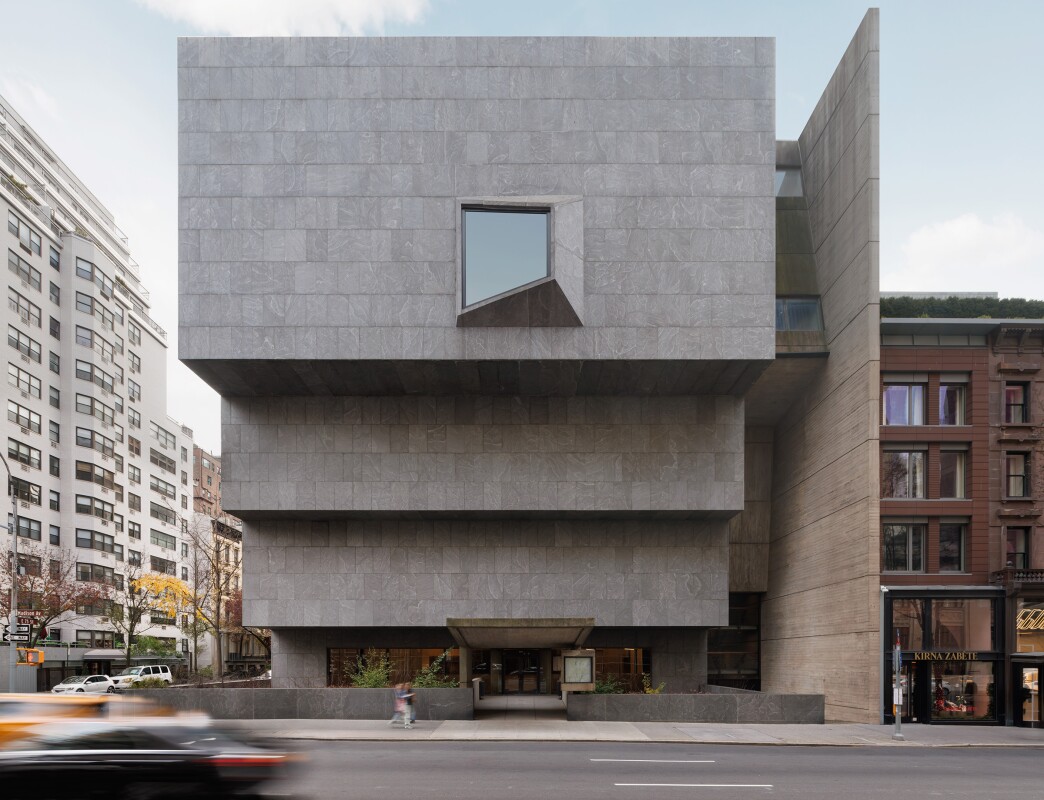
Of course, not everyone was in love with the structure at 75th and Madison, where Jacqueline Kennedy watched the ribbon cutting in 1966. Ada Louise Huxtable, art critic for The New York Times, feared it was too “somber and severe for many tastes,” and art critic Emily Genauer, writing in The New York Herald Tribune, found it “oppressively heavy.” She even dubbed it “the Madison Avenue Monster.” Criticism at the time reflected the divisiveness of Brutalism more generally – and especially its monolithic presence in a corridor of the Upper East Side decorated with brownstones and affluent residences. Little more than a decade later, some thought the museum ought to expand.

In 1981, the Upper East Side Historic District was designated a landmark district – yet the Breuer building, which remained divisive, was not officially marked for preservation. That is, until just this year, when the modernist building achieved its rightful place in architectural history. On May 20, 2025, the New York City Landmarks Preservation History designated the building and its interior an official landmark in a vote endorsed by Sotheby’s.
Both the Met and Sotheby’s have restored elements of the Breuer building before moving in, attending especially to beloved elements such as its concrete light fixtures and concrete staircase. Yet throughout every stage of its life, Marcel Breuer’s building has remained immutable in its devotion to the idea that a modern building can encourage a spiritual outlook toward art. His unapologetically heavy, sculptural form has changed the way we look at buildings – and art museums – forever.
Josef Albers, Hinnerk Scheper, Georg Muche, Laslo Moholy-Nagy, Herbert Bayer, Joost Schmidt, Walter Gropius, Marcel Breuer, Wassily Kandinsky, Paul Klee, Lyonel Feininger, Gunta Stozl and Oskar Schlemmer on the roof of the Bauhaus in Weimar, Germany, c. 1920. Image via PVDE / Bridgeman Images