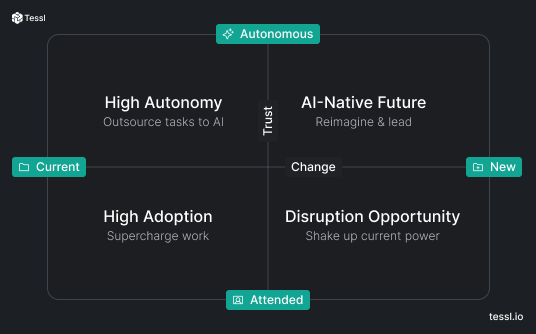
At the top right sits our destination – the future. This quadrant holds solutions assuming users have both adapted to new, AI-native, workflows, and have built up trust that the tools will get it right. Representatives of this quadrant often feel like sci-fi, as it’s hard to say how far into the future we should be looking. Sometimes, you can imagine a change happening in 3-5 years. Other times, macro changes are required, and we may be talking decades.
Let’s take AI corporate lawyers as an example. Highlighting risky clauses to a lawyer is a bottom-left quadrant productivity booster, while outsourcing legal negotiation to an AI agent requires substantial trust. Once such AI lawyers get trust and adoption, change will start. AI’s will start negotiating with each other, reaching conclusions almost instantly and with far less cost. The skills needed to be a great corporate lawyer will change, and new law firms may employ more developers and data scientists than lawyers.
If that happens, how would our use of legal change? Would ease and cost have us establish contracts more often? Would AI-created claims overwhelm courts and judges, requiring them to use AI to cope? And how would we deal with the risk and cost of flawed legal advice? Startups with a strong vision can aim to define this future reality, lobbying and building solutions to steer markets and society towards them. They can disrupt the incumbents, and set themselves up to lead the new reality.
Similar evolutions can be applied to many domains. If self-driving cars become the norm, urban planning, traffic laws and car insurance will drastically change. If music becomes AI-generated, static songs may become dynamic, collaboratively created with the listener – a new kind of active listening. If AI therapists become accepted, therapy would be more accessible, and perhaps we tackle society’s growing anxiety. These destinations are wild, scary to some and exciting to others, and they all present opportunities to shape and lead the destination.
What about Tessl?
I’ll use Tessl as the last example of the Future quadrant. Bottom-left coding assistants will eventually evolve into top-left autonomous engineers, producing code at a pace requiring AI maintenance to keep up. And yet, code remains the true representation of an application, and the center of software development – is that really the desired destination?
We believe the true future comes when we detach ourselves from the code. When we allow users to specify what they want, and have AI handle the how. This will let us create an iPhone or Android version from the same spec, optimize implementations to every org’s surroundings, and have software that is autonomously maintained. Furthermore, it will enable anyone to create software, without needing to know how to code and practically instantly.
Such AI-Native software development won’t be done with current tooling. Writing, editing, testing, evolving and distributing specs and adaptive implementations requires a new software factory – which is what we’re building. Embracing a new paradigm requires substantial change and a fair bit of trust, so it won’t happen overnight. However, the move from a code-centric to a spec-centric software development paradigm offers an opportunity to reimagine the software development world – and lead it.
Journeying through the quadrants
In practice, companies and solutions will journey through these quadrants. As a builder, investor and consumer in new AI tools, I try to understand where they play today and how they intend to move through the dimensions.
Here’s my high level guideline:
If you build purely for the top right today, you won’t get users, as change and trust develop slowly. However, if you focus only on the bottom left, you will face fierce competition, and risk becoming irrelevant as the world embraces new ways of working. A startup’s vision should always anchor in the future (to be relevant tomorrow), but execution should start from the bottom left (to get adoption today), and chart a journey to the top right.
That said, many journeys can be viable, even within the same industry. Tesla started in Adoption with Autopilot driver assistance, and is moving into Autonomy with Robotaxis, while Waymo started there right away, focusing on IP and relying on partnerships to get adoption. Synthesia started from the bottom right (Change), using attended and short videos, and will require more trust as they produce bigger pieces for consumer media. Isomorphic Labs seems to be building directly for the Future, but offering easier to adopt research helpers that fit somewhere in the bottom half.
When I look at building, investing in or even consuming a solution where AI is the core, I find it helpful to understand where they place on this map, and chart their potential journeys. It often clarifies what strengths are needed in the long run, who would be future competitors, and what GTM strategy is right.
At Tessl, we’re clearly anchored on the top right. As to what our journey there would look like… stay tuned, and you’ll find out 😉